When One Parent Refuses to Communicate: How Courts in Athens and Southeastern Ohio View Co-Parenting Breakdowns

By Andrew Russ, Ohio Father’s Rights Attorney
Family law disputes in Athens and Southeastern Ohio often arise not from dramatic violations of court orders, but from quieter, more persistent problems. One of the most common—and most misunderstood—of these problems is the breakdown of communication between parents. When one parent refuses to communicate, responds selectively, or engages only when it suits their interests, the effects can ripple far beyond inconvenience. Over time, communication failures can influence how courts evaluate co-parenting arrangements, shared parenting viability, and the overall best interests of a child.

In smaller communities throughout Southeastern Ohio—where schools, medical providers, and extracurricular activities are often deeply interconnected—communication between parents takes on heightened importance. Missed messages or withheld information can affect a child’s education, health care, and emotional stability in ways that are immediately visible to teachers, counselors, and guardians ad litem. As a result, courts in this region tend to look closely at how parents communicate, even when no single incident appears to violate a specific court order.

This article explores how courts in Athens and Southeastern Ohio commonly view co-parenting communication breakdowns, why non-communication matters, and how these patterns can shape long-term custody and parenting time outcomes.


Communication as a Core Part of Co-Parenting

Although custody and parenting time orders often focus on schedules, exchanges, and decision-making authority, communication is the connective tissue that allows those arrangements to function. Courts generally expect parents to exchange basic information related to their child’s schooling, medical care, and daily life. When communication breaks down, even a carefully crafted parenting plan can become unworkable.

In Southeastern Ohio, this reality is especially pronounced. Many families rely on a limited number of schools, doctors, and childcare providers. Activities may require coordination across long distances, and weather, transportation, and work schedules can introduce additional complications. In this context, communication failures are not abstract problems—they are practical obstacles that courts see reflected in missed appointments, school confusion, and escalating parental conflict.

Judges in Athens and surrounding counties often recognize that co-parenting is not simply about time allocation. It is also about whether parents can exchange information in a way that supports stability for the child. When communication stops or becomes adversarial, courts may view that breakdown as a substantive co-parenting issue rather than a minor interpersonal dispute.


Common Communication Breakdowns Seen in Southeastern Ohio Cases

Courts and guardians ad litem frequently encounter recurring patterns of communication problems. These patterns tend to matter more than isolated incidents, particularly when they repeat over months or years.

One common issue involves complete non-response. One parent may send messages related to school events, medical appointments, or schedule coordination, only to receive no reply. While silence may appear neutral on its face, courts often examine whether that silence interferes with the child’s needs or creates avoidable conflict.

Another pattern involves selective communication. A parent may respond only when it benefits them, while ignoring messages that require cooperation or compromise. This can include sharing information about extracurricular activities but withholding school notices, or responding promptly to schedule changes while remaining silent on medical updates.

Hostile or inflammatory communication is also frequently cited in court proceedings. Messages that escalate conflict, include insults, or provoke emotional reactions can undermine co-parenting relationships and expose children to ongoing tension. In smaller communities, this behavior may also surface indirectly through school staff or counselors who observe the child’s stress.

Finally, some parents rely on children as intermediaries. When parents refuse to communicate directly, children may be placed in the role of messenger, carrying information about schedules, conflicts, or grievances. Courts often view this dynamic as particularly concerning, as it places emotional burdens on children that they are not equipped to manage.


How Courts Evaluate Communication Patterns

Courts in Athens and Southeastern Ohio tend to focus less on single messages and more on overall patterns. Judges often look for consistency over time: whether communication problems are occasional lapses or sustained behaviors that interfere with co-parenting.

Credibility plays a significant role in this evaluation. Courts may consider whether one parent’s account of communication difficulties aligns with other evidence, such as school records, medical documentation, or third-party observations. In some cases, testimony from teachers, counselors, or guardians ad litem provides insight into how parental communication—or lack thereof—affects the child’s daily life.

Courts also assess the practical impact of communication failures. If missed messages lead to missed school events, confusion about medical care, or repeated scheduling disputes, judges may view communication breakdowns as directly affecting the child’s stability. In Southeastern Ohio, where resources may be limited and travel distances significant, these practical effects can carry substantial weight.

Importantly, courts often distinguish between unavoidable communication challenges and those that appear intentional. Patterns that suggest obstruction, control, or avoidance may be viewed differently than misunderstandings or temporary conflicts arising during stressful periods.


Why Non-Communication Can Matter Even Without a Clear Violation

Many parents assume that communication issues are irrelevant unless a court order explicitly mandates certain forms of contact. However, courts often evaluate conduct in light of broader principles governing custody and parenting time, rather than relying solely on technical compliance.

Even when an order does not specify communication methods, persistent non-communication may influence how courts assess a parent’s willingness to foster cooperation. Courts generally expect parents to act in ways that support the child’s relationship with both parents. When communication breakdowns undermine that relationship, courts may view the issue as relevant to broader custody considerations.

Guardians ad litem frequently play a key role in this analysis. In their investigations, GALs often focus on how parents communicate, resolve disagreements, and share information. Their reports may highlight patterns of non-communication or conflict, particularly when those patterns affect the child’s emotional well-being or sense of security.

In Southeastern Ohio, where courts aim to reduce repeated litigation and promote workable parenting arrangements, communication issues can become a focal point in custody reviews and modification proceedings.


Common Myths About Co-Parenting Communication

Several misconceptions frequently arise in cases involving communication breakdowns. One common belief is that silence cannot be held against a parent if no explicit rule requires communication. In practice, courts often look beyond formal requirements to evaluate how parental behavior affects the child.

Another myth is that communication issues are purely personal conflicts with no legal relevance. While courts do not intervene in every disagreement, sustained communication failures that affect the child’s daily life may carry significant weight.

Some parents also believe that avoiding communication reduces conflict. In reality, courts often view prolonged silence as a source of instability rather than a solution, particularly when it forces children or third parties to fill the communication gap.

Addressing these misconceptions is not about assigning blame, but about understanding how courts interpret behavior within the broader framework of co-parenting responsibilities.


The Role of Small-Community Dynamics

Athens and Southeastern Ohio present unique dynamics that shape how communication issues are perceived. In smaller communities, parents are more likely to encounter one another through schools, medical providers, and community events. Information gaps are more noticeable, and disruptions can have immediate effects on a child’s routine.

Courts in this region often recognize that effective co-parenting requires a baseline level of cooperation. When communication breakdowns persist, they may signal deeper issues with shared parenting feasibility. Judges may consider whether existing arrangements realistically reflect how parents interact in practice.

Additionally, limited access to specialized services can amplify the consequences of poor communication. Missed appointments or delayed information may not be easily remedied, increasing the importance of timely and reliable exchanges between parents.


How Communication Breakdowns Shape Court Outcomes

While courts do not automatically alter custody arrangements based on communication problems, these issues often influence broader evaluations. Judges may consider whether communication patterns support or undermine shared decision-making, whether ongoing conflict exposes the child to stress, and whether existing arrangements remain workable.

In some cases, courts may reevaluate how parental responsibilities are allocated, particularly when communication failures interfere with decision-making related to education or medical care. Courts may also consider whether structured communication tools or protocols are necessary to reduce conflict, though the specific outcomes depend on the facts of each case.

The key point is that communication issues rarely exist in isolation. They are often intertwined with broader concerns about cooperation, stability, and the child’s best interests.


Why Courts Emphasize Cooperation in Southeastern Ohio

Courts in Athens and surrounding counties often emphasize cooperation as a practical necessity. With fewer institutional resources and greater reliance on parents to manage logistics, effective communication becomes essential to minimizing conflict and protecting children from ongoing disputes.

Repeated litigation over communication issues can strain court resources and prolong instability for families. As a result, courts may scrutinize communication patterns closely when evaluating whether existing arrangements promote long-term stability.

This emphasis on cooperation does not mean that courts expect perfection. Rather, they often look for reasonable efforts to exchange information and manage conflict in ways that prioritize the child’s needs.


Understanding the Broader Implications

Communication breakdowns are among the most common—and most underestimated—issues in Ohio family law cases. In Athens and Southeastern Ohio, where community dynamics and logistical realities amplify their effects, these issues can shape how courts view co-parenting arrangements over time.

By examining patterns rather than isolated incidents, courts seek to understand how parental behavior affects a child’s daily life. Non-communication, selective responses, and hostile exchanges may all factor into broader custody evaluations, even when no single action appears to violate a court order.

Understanding how courts view these issues can help parents, practitioners, and observers better grasp the role communication plays in co-parenting and custody decisions—particularly in the unique context of Southeastern Ohio.


How Andrew Russ Advocates for Ohio Fathers

Clear strategy from day one: We map the custody/visitation path that fits your goals and facts.

Focused evidence development: We identify the proof that matters—and cut what doesn’t.

Negotiation + litigation readiness: Many cases resolve with strong parenting plans; we’re prepared to try your case when necessary.

Local insight: Familiarity with Ohio courts and procedures helps us move efficiently and effectively.

Call Now:

Ready to take the next step? Schedule a strategy session with Andrew Russ, Ohio Family Law Attorney. Call (614) 907-1296 or complete our quick online consultation form to get started. Evening and virtual appointments available.


Legal Sources on Parenting Issues:

  • Ohio allocation of parental rights & shared parenting (R.C. 3109.04). (Ohio Laws)
  • Parenting time statute and scheduling (R.C. 3109.051). (Ohio Laws)
  • Presumptions and establishment of paternity (R.C. 3111.03). (Ohio Laws)
  • Paternity acknowledgment routes (Ohio Centralized Paternity Registry). (ODJFS)
  • Child support worksheet and definitions (R.C. 3119.022; 3119.01). (Ohio Laws)

andrewrusslaw.com Blog:

Disclaimer: This article provides general information and is not legal advice. Legal outcomes vary by facts and jurisdiction. Consult an attorney about your specific situation.


LINKS:

https://www.andrewrusslaw.com/

https://share.google/jt5uwH1ApFQIzrRdU

https://maps.app.goo.gl/XGHud9PfpxUR7hmJA

https://www.andrewrusslaw.com/contact

https://buckeyefatherslaw.com/

https://www.yelp.com/biz/buckeye-fathers-law-pickerington

https://www.andrewrusslaw.com/in-person-representation

https://www.andrewrusslaw.com/team

https://www.andrewrusslaw.com/blog

https://www.andrewrusslaw.com/about-1

https://andrewrusslaw.blog/

https://www.ohiobar.org/

https://www.supremecourt.ohio.gov/

https://codes.ohio.gov/ohio-revised-code

https://drj.fccourts.org/

https://www.co.athensoh.org/departments/domestic_relations_division.php

Disclaimer: The blog and articles provide general educational information, are not legal advice, and do not create an attorney/client relationship. Legal outcomes vary by facts and jurisdiction. Consult an attorney about your specific situation.

© Andrew Russ Law, LLC • Educational content

How Ohio Courts Handle Grandparents’ Rights and Third-Party Custody: An Educational Overview for Parents and Fathers in Athens, Central, and Southeastern Ohio

By Andrew Russ, Ohio Father’s Rights Attorney

Ohio family law cases most often involve disputes between parents. Yet some of the most emotionally complex cases arise when a person other than a parent—most commonly a grandparent—seeks court-ordered involvement in a child’s life. These situations frequently emerge during periods of instability, such as divorce, the death of a parent, serious illness, military deployment, incarceration, or juvenile court involvement.

For fathers, third-party custody and grandparent visitation disputes can feel especially unsettling. Ohio law strongly protects parental rights, but it also recognizes limited circumstances in which courts may consider requests from grandparents or other non-parents. Understanding how Ohio courts analyze these cases helps families better understand why judges rule the way they do and what legal principles guide those decisions.

This article provides an educational overview of how Ohio courts approach grandparents’ rights and third-party custody issues. It is intended to explain the legal framework courts use and the practical realities families often encounter, without offering legal advice.

What “Grandparents’ Rights” Means Under Ohio Law

The term “grandparents’ rights” is commonly used but often misunderstood. Ohio law does not grant grandparents automatic rights to custody or visitation based solely on their biological relationship to a child. Any rights a grandparent may have arise only through specific statutes and are subject to careful judicial review.

In most cases, grandparents seek either visitation or custody. These are legally distinct concepts. Visitation involves limited, court-ordered time with a child while parental authority remains intact. Custody involves the transfer of decision-making authority over the child’s care, education, and upbringing. Because custody directly interferes with a parent’s fundamental rights, Ohio courts examine such requests with heightened scrutiny.

Third-Party Custody Versus Visitation

The distinction between third-party custody and third-party visitation is central to these cases. When a non-parent seeks custody, the court is being asked to place that individual in a parental role. Ohio courts approach these requests cautiously because custody decisions permanently affect family structure and parental authority.

Visitation requests are evaluated differently. Courts may consider whether limited contact with a grandparent serves the child’s interests without undermining parental decision-making. Even so, parental objections carry significant weight.

When Ohio Courts Consider Grandparent or Third-Party Requests

Ohio courts do not consider third-party custody or visitation in every family situation. The law identifies specific contexts in which such requests may be reviewed.

The Best Interests of the Child and the Presumption Favoring Parents

Ohio courts apply a best-interests-of-the-child analysis in custody-related cases, but third-party disputes involve an additional layer of constitutional protection for parents.

Fathers and Third-Party Custody Disputes

Ohio law does not treat fathers as secondary parents. Courts evaluate parental rights without regard to gender.

Juvenile Court and Domestic Relations Court

Third-party custody and visitation issues may be addressed in domestic relations court or juvenile court.

Practical Realities Families Often Overlook

Third-party custody disputes can be emotionally taxing, time-consuming, and costly.

Balancing Stability and Parental Rights

Ohio courts strive to balance child stability with parental rights.

Final Thoughts

Grandparents’ rights and third-party custody cases occupy a delicate space in Ohio family law.

How Andrew Russ Advocates for Ohio Fathers

  • Clear strategy from day one: We map the custody/visitation path that fits your goals and facts.
  • Focused evidence development: We identify the proof that matters—and cut what doesn’t.
  • Negotiation + litigation readiness: Many cases resolve with strong parenting plans; we’re prepared to try your case when necessary.
  • Local insight: Familiarity with Ohio courts and procedures helps us move efficiently and effectively.

Call Now:

Ready to take the next step? Schedule a strategy session with Andrew Russ, Ohio Family Law Attorney. Call (614) 907-1296 or complete our quick online consultation form to get started. Evening and virtual appointments available.


Legal Sources on Parenting Issues:

  • Ohio allocation of parental rights & shared parenting (R.C. 3109.04). (Ohio Laws)
  • Parenting time statute and scheduling (R.C. 3109.051). (Ohio Laws)
  • Presumptions and establishment of paternity (R.C. 3111.03). (Ohio Laws)
  • Paternity acknowledgment routes (Ohio Centralized Paternity Registry). (ODJFS)
  • Child support worksheet and definitions (R.C. 3119.022; 3119.01). (Ohio Laws)

andrewrusslaw.com Blog:

Disclaimer: This article provides general information and is not legal advice. Legal outcomes vary by facts and jurisdiction. Consult an attorney about your specific situation.


LINKS:

https://www.andrewrusslaw.com/

https://share.google/jt5uwH1ApFQIzrRdU

https://maps.app.goo.gl/XGHud9PfpxUR7hmJA

https://www.andrewrusslaw.com/contact

https://buckeyefatherslaw.com/

https://www.yelp.com/biz/buckeye-fathers-law-pickerington

https://www.andrewrusslaw.com/in-person-representation

https://www.andrewrusslaw.com/team

https://www.andrewrusslaw.com/blog

https://www.andrewrusslaw.com/about-1

https://andrewrusslaw.blog/

https://www.ohiobar.org/

https://www.supremecourt.ohio.gov/

https://codes.ohio.gov/ohio-revised-code

https://drj.fccourts.org/

https://www.co.athensoh.org/departments/domestic_relations_division.php

Disclaimer: The blog and articles provide general educational information, are not legal advice, and do not create an attorney/client relationship. Legal outcomes vary by facts and jurisdiction. Consult an attorney about your specific situation.

© Andrew Russ Law, LLC • Educational content only • Columbus & Athens, Ohio

Digital Evidence in Ohio Family Law Cases: How Courts in Athens, Central, and Southeastern Ohio Commonly View Texts, Emails, and Co‑Parenting App Records

By Andrew Russ, Ohio Father’s Rights Attorney

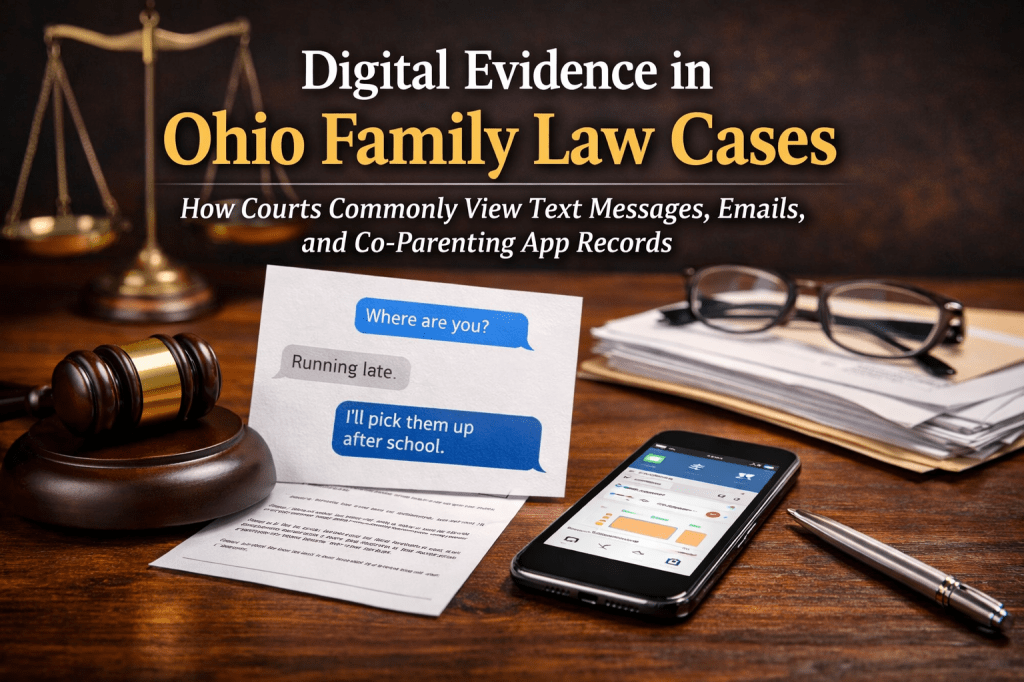
Family law disputes in Ohio increasingly unfold in a digital environment. Parents who once relied on phone calls, handwritten notes, or in‑person conversations now communicate primarily through text messages, emails, and structured co‑parenting platforms. In domestic relations and juvenile courts across Athens, Central Ohio, and Southeastern Ohio, judges regularly encounter disputes where electronic communication forms a significant part of the factual background. Understanding how courts commonly view and evaluate this material provides valuable educational insight into modern family‑law proceedings.

This article offers an educational overview of how Ohio family courts generally approach digital evidence in custody, parenting‑time, and support‑related cases. Rather than providing instruction or legal advice, it explains recurring themes seen in courtroom practice and judicial reasoning, particularly in courts serving Athens County, Franklin County, and surrounding Southeastern Ohio jurisdictions.

Digital Communication and the Modern Ohio Family Law Case

Family law cases reflect broader social changes. As daily life has shifted toward digital communication, family courts have adapted to evaluating new forms of information. Text messages between parents, email exchanges regarding schedules or expenses, and records generated by co‑parenting applications now appear routinely in hearings and filings.

In Ohio domestic relations and juvenile courts, digital communication often arises in cases involving parenting‑time disputes, allegations of poor communication between parents, or disagreements about compliance with court orders. Judges do not view this trend as unusual. Instead, electronic records are now treated as a common category of evidence that must be examined alongside testimony, financial documents, school records, and other traditional materials.

Courts in Athens and Southeastern Ohio often see cases where parents live in different towns or counties, making electronic communication the primary means of coordination. Central Ohio courts, particularly in larger metropolitan areas, similarly encounter extensive digital records due to busy schedules and complex parenting arrangements. Across these regions, the presence of digital evidence reflects the realities of modern co‑parenting rather than an exceptional circumstance.

Common Types of Digital Evidence Seen in Ohio Family Courts

Ohio family courts encounter a wide range of electronic materials. While the specific content varies from case to case, several categories appear with notable frequency.

Text messages are among the most common forms of digital communication presented in custody and parenting‑time matters. These may include conversations about exchanges, schedule changes, school events, or disagreements between parents. Courts often see both isolated messages and longer message threads spanning weeks or months.

Email correspondence also plays a significant role, particularly in cases involving more formal communication. Emails regarding education, medical care, extracurricular activities, or financial matters often appear in contested proceedings. Because emails typically contain date and time information, courts frequently review them as part of broader factual narratives.

Screenshots of messages or social‑media content are another recurring form of digital evidence. These images may capture portions of conversations, posts, or comments that parties believe are relevant to parenting issues. Courts commonly examine screenshots alongside other materials to understand their context and significance.

Co‑parenting application records have become increasingly common in Ohio cases. These platforms generate structured communication logs, calendars, and activity records. Judges in Athens, Central Ohio, and Southeastern Ohio regularly encounter references to such platforms in both domestic relations and juvenile court matters.

Finally, courts sometimes review social‑media content when it relates directly to parenting issues. While not every online post is relevant, courts may encounter social‑media material when it intersects with allegations raised during litigation.

How Ohio Courts Commonly Evaluate Digital Evidence

Ohio family courts do not treat digital evidence as inherently decisive or insignificant. Instead, judges commonly evaluate electronic records using the same foundational principles applied to other forms of evidence.

One recurring theme in judicial analysis is authenticity. Courts typically examine whether the digital material appears to be a genuine record of communication rather than an altered or incomplete representation. This assessment often involves considering the source of the material, the consistency of formatting, and whether the content aligns with other evidence in the case.

Context also plays a central role in how judges view digital communication. Isolated messages may carry limited meaning when viewed alone. Courts frequently look at surrounding communications, timing, and circumstances to understand what a particular message reflects about the parties’ interactions.

Timing and continuity are additional factors courts often consider. Judges may note whether digital records reflect ongoing patterns of communication or isolated incidents. In custody and parenting‑time disputes, courts commonly focus on trends rather than singular exchanges.

Completeness is another recurring consideration. Partial message threads or selected screenshots may be weighed differently than complete communication histories. Courts often prefer to understand how conversations unfolded over time rather than relying solely on excerpts.

Screenshots Versus Full Communication Records

Ohio family courts regularly encounter both screenshots and longer communication logs. Judges are familiar with the practical differences between these formats and often take those differences into account.

Screenshots typically present a snapshot of a specific moment. They may capture language, tone, or reactions that parties believe are significant. However, courts frequently note that screenshots may omit surrounding context, earlier messages, or subsequent responses. As a result, judges often treat screenshots as part of a larger evidentiary picture rather than as standalone proof.

Full communication records, such as message exports or application‑generated logs, tend to provide a broader view of interactions. These materials may show frequency, consistency, and changes over time. Courts in Athens and Central Ohio often emphasize the value of understanding communication patterns rather than focusing exclusively on individual messages.

That distinction does not mean one format is always preferred. Instead, courts typically consider how each type of record contributes to understanding the factual circumstances presented in the case.

Co‑Parenting Applications and Judicial Perspectives

Co‑parenting applications have become increasingly visible in Ohio family law proceedings. Courts encounter these platforms both when their use has been ordered and when parents have voluntarily adopted them.

Judges commonly view application records as structured forms of communication that can reflect scheduling coordination, responsiveness, and consistency. Because these platforms often log dates and times automatically, courts may consider them useful for understanding how communication unfolded.

At the same time, Ohio courts generally recognize that application records represent one aspect of the overall parenting dynamic. Judges often evaluate these records alongside testimony, school records, and other evidence rather than treating them as determinative.

In Southeastern Ohio jurisdictions, where parents may live some distance apart, co‑parenting applications frequently appear in cases involving transportation, exchanges, and coordination across county lines. In Central Ohio, courts often see application records in more complex cases involving multiple activities and shared parenting plans.

The Limits of Digital Evidence in Ohio Family Law Cases

Despite the growing role of electronic communication, Ohio courts consistently emphasize that digital evidence rarely resolves family law disputes on its own. Judges typically view digital records as part of a broader evidentiary framework.

Family law cases often involve nuanced questions about credibility, parenting capacity, and the best interests of children. Digital communication may illustrate aspects of those issues, but courts generally rely on multiple sources of information.

Judges also recognize that digital communication can be influenced by stress, conflict, or misinterpretation. As a result, courts often avoid drawing sweeping conclusions based solely on electronic messages without corroborating evidence.

This measured approach is consistent across Athens, Central Ohio, and Southeastern Ohio courts. While digital evidence is now routine, it is rarely viewed in isolation.

Why Educational Understanding Matters

Misunderstandings about digital evidence can create unrealistic expectations about family court proceedings. Some parties assume that a single message or screenshot will carry decisive weight. Others believe digital communication is irrelevant or ignored.

Ohio family courts occupy a middle ground. Judges routinely review electronic records, but they do so within established evidentiary principles and broader factual contexts. Understanding this approach helps explain why courts often focus on patterns, credibility, and overall circumstances rather than isolated digital moments.

For parents navigating family law matters in Athens, Central Ohio, or Southeastern Ohio, recognizing how courts commonly evaluate digital communication provides clarity about modern judicial practice. It underscores that technology has changed the form of evidence, but not the foundational reasoning courts apply when resolving family disputes.

Conclusion

Digital evidence has become a normal feature of Ohio family law cases. Text messages, emails, screenshots, and co‑parenting application records now appear regularly in custody, parenting‑time, and support proceedings across Athens, Central Ohio, and Southeastern Ohio.

Ohio courts approach these materials with careful analysis, focusing on authenticity, context, timing, and completeness. Rather than elevating digital evidence above all else, judges incorporate it into broader evaluations that include testimony and traditional documentation.

As family law continues to evolve alongside technology, understanding how courts commonly view digital communication remains an important educational topic. By examining judicial perspectives rather than offering instruction, this overview highlights how modern family courts adapt to contemporary forms of evidence while maintaining consistent analytical principles.

How Andrew Russ Advocates for Ohio Fathers

  • Clear strategy from day one: We map the custody/visitation path that fits your goals and facts.
  • Focused evidence development: We identify the proof that matters—and cut what doesn’t.
  • Negotiation + litigation readiness: Many cases resolve with strong parenting plans; we’re prepared to try your case when necessary.
  • Local insight: Familiarity with Ohio courts and procedures helps us move efficiently and effectively.

Call Now:

Ready to take the next step? Schedule a strategy session with Andrew Russ, Ohio Family Law Attorney. Call (614) 907-1296 or complete our quick online consultation form to get started. Evening and virtual appointments available.


Legal Sources on Parenting Issues:

  • Ohio allocation of parental rights & shared parenting (R.C. 3109.04). (Ohio Laws)
  • Parenting time statute and scheduling (R.C. 3109.051). (Ohio Laws)
  • Presumptions and establishment of paternity (R.C. 3111.03). (Ohio Laws)
  • Paternity acknowledgment routes (Ohio Centralized Paternity Registry). (ODJFS)
  • Child support worksheet and definitions (R.C. 3119.022; 3119.01). (Ohio Laws)

andrewrusslaw.com Blog:

Disclaimer: This article provides general information and is not legal advice. Legal outcomes vary by facts and jurisdiction. Consult an attorney about your specific situation.


LINKS:

https://www.andrewrusslaw.com/

https://share.google/jt5uwH1ApFQIzrRdU

https://maps.app.goo.gl/XGHud9PfpxUR7hmJA

https://www.andrewrusslaw.com/contact

https://buckeyefatherslaw.com/

https://www.yelp.com/biz/buckeye-fathers-law-pickerington

https://www.andrewrusslaw.com/in-person-representation

https://www.andrewrusslaw.com/team

https://www.andrewrusslaw.com/blog

https://www.andrewrusslaw.com/about-1

https://andrewrusslaw.blog/

https://www.ohiobar.org/

https://www.supremecourt.ohio.gov/

https://codes.ohio.gov/ohio-revised-code

https://drj.fccourts.org/

https://www.co.athensoh.org/departments/domestic_relations_division.php

Disclaimer: The blog and articles provide general educational information, are not legal advice, and do not create an attorney/client relationship. Legal outcomes vary by facts and jurisdiction. Consult an attorney about your specific situation.

© Andrew Russ Law, LLC • Educational content only • Columbus & Athens, Ohio
Interstate Child Custody & the UCCJEA in Ohio

What Fathers in Central and Southeastern Ohio Should Understand When Parenting Across State Lines

By Andrew Russ, Ohio Father’s Rights Attorney

Families in Central and Southeastern Ohio are increasingly mobile. Employment opportunities in Columbus, Athens, Lancaster, and surrounding communities often pull parents across state lines. Military service, remarriage, and housing pressures also contribute to decisions that place parents—and sometimes children—in different states.

When those moves intersect with custody and parenting time, confusion often follows. Fathers frequently discover that custody disputes are not simply about fairness or convenience, but about which state has legal authority to decide issues at all. That authority is governed by the Uniform Child Custody Jurisdiction and Enforcement Act (UCCJEA).

This article provides an educational overview of how interstate custody issues are analyzed in Ohio. It does not provide legal advice.

Understanding the UCCJEA Framework


The UCCJEA is a uniform law adopted by Ohio and nearly every other state. Its purpose is to ensure that only one state at a time exercises custody jurisdiction, reducing conflicting orders and prolonged disputes. Ohio courts apply this framework before addressing the substance of custody or parenting time.

Jurisdiction and the Child’s Home State


Jurisdiction focuses on the child, not the parents. The child’s “home state” is typically the state where the child has lived for the required period immediately before the custody issue arises. This analysis can be counterintuitive and often surprises parents.

Existing Orders and Interstate Enforcement

Ohio courts generally respect valid custody orders issued by other states. This principle aligns with the approach discussed in Understanding Parenting Time & Custody Modifications in Ohio (https://www.andrewrusslaw.com/post/understanding-parenting-time-amp-custody-modifications-in-ohio-an-educational-overview-for-father).

Emergency Jurisdiction


Ohio courts may exercise temporary emergency jurisdiction in limited circumstances involving immediate concerns for a child’s safety. Such authority is narrow and does not automatically transfer long-term jurisdiction.

Relocation and Long-Distance Parenting

Interstate custody questions often arise alongside relocation issues. For related educational discussion, see Parental Relocation and Parenting Time in Ohio (https://www.andrewrusslaw.com/post/parental-relocation-and-parenting-time-in-ohio-an-educational-overview-of-how-courts-analyze-move-a).

Common Misconceptions


Parents often assume that physical presence alone determines jurisdiction or that moving automatically changes custody authority. The UCCJEA rejects these assumptions in favor of stability and continuity.

Why Jurisdiction Matters


Jurisdictional errors can delay proceedings and increase conflict. Courts prioritize determining authority early to minimize disruption for children and families.

Conclusion


Interstate custody law emphasizes stability over geography. By understanding the jurisdictional framework applied by Ohio courts, fathers can better navigate parenting arrangements that cross state lines.

Educational Disclaimer


This article is for general educational purposes only. It is not legal advice and does not create an attorney-client relationship. Family law matters are fact-specific, and outcomes vary depending on individual circumstances.

How Andrew Russ Advocates for Ohio Fathers

  • Clear strategy from day one: We map the custody/visitation path that fits your goals and facts.
  • Focused evidence development: We identify the proof that matters—and cut what doesn’t.
  • Negotiation + litigation readiness: Many cases resolve with strong parenting plans; we’re prepared to try your case when necessary.
  • Local insight: Familiarity with Ohio courts and procedures helps us move efficiently and effectively.

Call Now:

Ready to take the next step? Schedule a strategy session with Andrew Russ, Ohio Family Law Attorney. Call (614) 907-1296 or complete our quick online consultation form to get started. Evening and virtual appointments available.


Legal Sources on Parenting Issues:

  • Ohio allocation of parental rights & shared parenting (R.C. 3109.04). (Ohio Laws)
  • Parenting time statute and scheduling (R.C. 3109.051). (Ohio Laws)
  • Presumptions and establishment of paternity (R.C. 3111.03). (Ohio Laws)
  • Paternity acknowledgment routes (Ohio Centralized Paternity Registry). (ODJFS)
  • Child support worksheet and definitions (R.C. 3119.022; 3119.01). (Ohio Laws)

andrewrusslaw.com Blog:

Disclaimer: This article provides general information and is not legal advice. Legal outcomes vary by facts and jurisdiction. Consult an attorney about your specific situation.


LINKS:

https://www.andrewrusslaw.com/

https://share.google/jt5uwH1ApFQIzrRdU

https://maps.app.goo.gl/XGHud9PfpxUR7hmJA

https://www.andrewrusslaw.com/contact

https://buckeyefatherslaw.com/

https://www.yelp.com/biz/buckeye-fathers-law-pickerington

https://www.andrewrusslaw.com/in-person-representation

https://www.andrewrusslaw.com/team

https://www.andrewrusslaw.com/blog

https://www.andrewrusslaw.com/about-1

https://andrewrusslaw.blog/

https://www.ohiobar.org/

https://www.supremecourt.ohio.gov/

https://codes.ohio.gov/ohio-revised-code

https://drj.fccourts.org/

https://www.co.athensoh.org/departments/domestic_relations_division.php

Disclaimer: The blog and articles provide general educational information, are not legal advice, and do not create an attorney/client relationship. Legal outcomes vary by facts and jurisdiction. Consult an attorney about your specific situation.

© Andrew Russ Law, LLC • Educational content only • Columbus & Athens, Ohio

How School Attendance, Extracurricular Activities, and Educational Needs Affect Parenting Time and Custody Decisions in Ohio


By Andrew Russ, Ohio Father’s Rights Attorney

In Ohio custody and parenting time cases, few issues are as consistently influential—and as frequently misunderstood—as a child’s education. While parents often view school schedules, extracurricular activities, and academic needs as practical logistics to be worked out informally, Ohio courts regularly treat these factors as central to determining a child’s best interests. From Columbus and Central Ohio to Athens and communities throughout Southeastern Ohio, judges and magistrates evaluate educational stability as a cornerstone of a child’s well-being.

This article provides an educational overview of how school attendance, extracurricular commitments, and special educational needs can shape parenting time and custody orders in Ohio. It is intended to explain how courts typically analyze these issues, not to provide legal advice or direction in any individual case.

Ohio’s Best-Interest Framework and Education

Ohio custody determinations are guided by the “best interest of the child” standard. While the statute does not elevate education above all other factors, schooling is often woven into multiple elements of the analysis. Courts look closely at a child’s need for stability, routine, and continuity—factors that naturally intersect with where the child attends school, how reliably they attend, and which parent is better positioned to support educational success.

In both initial custody determinations and modification proceedings, courts often consider which parent has historically managed school communications, attended conferences, supported homework routines, and coordinated schedules around the academic calendar. These considerations arise in divorce cases, post-decree disputes, and actions involving unmarried parents alike.

School Attendance and Geographic Stability

School attendance frequently becomes a focal point when parents live in different school districts or communities. In Central Ohio, where commuting distances can be significant even within the same metropolitan area, courts often examine whether a proposed parenting schedule would disrupt a child’s school routine or impose excessive travel burdens.

Similarly, in Athens and Southeastern Ohio—where school districts may cover large rural areas—transportation logistics and travel time can weigh heavily in parenting time decisions. Courts may be concerned when frequent exchanges interfere with consistent school attendance or when a parenting schedule requires a child to spend extensive time traveling on school days.

When parents share parenting time, courts often favor arrangements that minimize school-night disruptions. This does not necessarily mean equal parenting time is disfavored, but it does mean that schedules are often shaped around school start times, homework demands, and the child’s ability to arrive at school rested and prepared.

Extracurricular Activities and Court Consideration

Extracurricular activities—sports, music, academic clubs, and community programs—are another area where education and parenting time intersect. Ohio courts generally recognize that these activities contribute to a child’s development and social stability. As a result, parenting time orders often account for established extracurricular commitments.

Conflicts can arise when activities occur during one parent’s scheduled time or require transportation across long distances. Courts typically look at the history of the activity, the child’s level of involvement, and whether participation is consistent with the child’s overall best interests. Longstanding commitments are often treated differently than newly introduced activities, particularly if they significantly interfere with the other parent’s parenting time.

In practice, courts frequently expect parents to cooperate around activity schedules. Where cooperation breaks down, judges may craft more specific parenting time provisions addressing transportation responsibilities, attendance expectations, and communication obligations related to extracurriculars.

Educational Decision-Making Authority

School-related issues also intersect with legal custody, particularly decision-making authority. When parents share legal custody, educational decisions—such as school selection, special services, and academic interventions—are typically shared. Disputes over these issues can arise even when parenting time itself is not contested.

In cases where one parent is designated as the residential parent for school purposes, that designation can carry significant weight. Courts may view it as promoting stability by centralizing educational decision-making, especially when parents have demonstrated difficulty cooperating.

Special Education and Additional Educational Needs

Children with special educational needs often present unique considerations in custody and parenting time cases. Individualized Education Programs (IEPs), 504 Plans, therapy schedules, and specialized transportation services all factor into how courts evaluate a child’s daily routine.

Ohio courts generally recognize the importance of consistency for children receiving special education services. Parenting schedules that disrupt therapy sessions, interfere with school-based supports, or complicate service delivery may be scrutinized more closely. Courts may consider which parent is more familiar with the child’s educational plan, which parent attends IEP meetings, and how each household supports the child’s learning needs.

These considerations can influence both parenting time allocation and school placement decisions. In some cases, courts may prioritize maintaining a child’s enrollment in a particular school or district to ensure continuity of services.

Parenting Time Modifications Based on Educational Changes

Educational changes can sometimes form the basis for modifying an existing parenting time order. A change in school placement, academic needs, or extracurricular demands may alter the practical functioning of an established schedule. Ohio courts typically examine whether such changes constitute a substantial change in circumstances and whether modification would serve the child’s best interests.

Common scenarios include transitions from elementary to middle school, increased academic workload in high school, or the introduction of specialized programs requiring consistent attendance. Courts may also consider whether an existing schedule, once workable, has become disruptive or impractical as the child’s educational responsibilities evolve.

Documentation and Court Evaluation

In custody-related proceedings, courts rely heavily on documentation to understand how education affects a child’s daily life. School attendance records, teacher communications, report cards, and extracurricular schedules often become relevant. Courts may also consider testimony from parents regarding homework routines, communication with schools, and responsiveness to academic concerns.

Importantly, courts are not evaluating which parent is “perfect,” but rather which arrangements best support the child’s educational stability and overall development. Consistency, reliability, and demonstrated engagement with the child’s schooling often carry significant weight.

Regional Considerations Across Ohio

While Ohio law is applied statewide, regional differences can shape how educational factors play out in custody cases. In Columbus and Central Ohio, dense school districts and heavy traffic can influence parenting schedules and transportation feasibility. In Southeastern Ohio, longer distances between homes and schools may heighten concerns about travel time and consistency.

Judges in all regions share a common focus on minimizing unnecessary disruption to a child’s education. However, local realities—school district boundaries, transportation infrastructure, and community resources—often influence how courts craft practical parenting time solutions.

Conclusion

Education is not a peripheral issue in Ohio custody and parenting time cases; it is often central to the court’s analysis of a child’s best interests. School attendance, extracurricular commitments, and special educational needs all intersect with parenting schedules and custody determinations in meaningful ways.

Understanding how courts typically evaluate these factors can help parents better anticipate how educational considerations may shape outcomes in their cases. While every family’s situation is unique, Ohio courts consistently emphasize stability, consistency, and the child’s long-term educational well-being when making custody-related decisions.

How Andrew Russ Advocates for Ohio Fathers

  • Clear strategy from day one: We map the custody/visitation path that fits your goals and facts.
  • Focused evidence development: We identify the proof that matters—and cut what doesn’t.
  • Negotiation + litigation readiness: Many cases resolve with strong parenting plans; we’re prepared to try your case when necessary.
  • Local insight: Familiarity with Ohio courts and procedures helps us move efficiently and effectively.

Call Now:

Ready to take the next step? Schedule a strategy session with Andrew Russ, Ohio Family Law Attorney. Call (614) 907-1296 or complete our quick online consultation form to get started. Evening and virtual appointments available.


Legal Sources on Parenting Issues:

  • Ohio allocation of parental rights & shared parenting (R.C. 3109.04). (Ohio Laws)
  • Parenting time statute and scheduling (R.C. 3109.051). (Ohio Laws)
  • Presumptions and establishment of paternity (R.C. 3111.03). (Ohio Laws)
  • Paternity acknowledgment routes (Ohio Centralized Paternity Registry). (ODJFS)
  • Child support worksheet and definitions (R.C. 3119.022; 3119.01). (Ohio Laws)

andrewrusslaw.com Blog:

Disclaimer: This article provides general information and is not legal advice. Legal outcomes vary by facts and jurisdiction. Consult an attorney about your specific situation.


LINKS:

https://www.andrewrusslaw.com/

https://share.google/jt5uwH1ApFQIzrRdU

https://maps.app.goo.gl/XGHud9PfpxUR7hmJA

https://www.andrewrusslaw.com/contact

https://buckeyefatherslaw.com/

https://www.yelp.com/biz/buckeye-fathers-law-pickerington

https://www.andrewrusslaw.com/in-person-representation

https://www.andrewrusslaw.com/team

https://www.andrewrusslaw.com/blog

https://www.andrewrusslaw.com/about-1

https://andrewrusslaw.blog/

https://www.ohiobar.org/

https://www.supremecourt.ohio.gov/

https://codes.ohio.gov/ohio-revised-code

https://drj.fccourts.org/

https://www.co.athensoh.org/departments/domestic_relations_division.php

Disclaimer: The blog and articles provide general educational information, are not legal advice, and do not create an attorney/client relationship. Legal outcomes vary by facts and jurisdiction. Consult an attorney about your specific situation.

© Andrew Russ Law, LLC • Educational content only • Columbus & Athens, Ohio

How Ohio Courts Evaluate Parental Fitness: Common Evidence, Myths, and What Really Matters in Custody Cases

By Andrew Russ, Ohio Father’s Rights Attorney

In Ohio custody cases, the phrase “parental fitness” is often used in conversation, online searches, and informal discussions among parents. Despite its frequent use, the concept is commonly misunderstood. Ohio courts do not apply a single test or checklist to determine whether a parent is “fit” or “unfit.” Instead, parental fitness is evaluated as part of a broader legal framework focused on the best interests of the child. Understanding how courts approach this evaluation can help reduce confusion and clarify what actually matters in custody decisions.

Ohio’s custody laws are structured around the principle that decisions affecting children should prioritize their health, safety, and overall well-being. Judges are tasked with weighing a range of statutory factors and factual circumstances, rather than awarding custody based on labels, assumptions, or isolated events. As a result, parental fitness is not about perfection, wealth, or popularity, but about how a parent’s conduct and circumstances relate to the child’s needs over time.

The Legal Framework: The Best Interests of the Child

In Ohio, custody determinations are governed by the “best interests of the child” standard. This standard directs courts to consider a wide range of factors that collectively inform whether a proposed custody or parenting arrangement supports the child’s physical, emotional, and developmental needs. Parental fitness is embedded within this analysis, rather than standing alone as a separate legal finding in most cases.

Courts consider how each parent has historically participated in the child’s life, how each parent supports the child’s education and health, and how each parent interacts with the other parent regarding shared responsibilities. No single factor is determinative, and the weight given to each consideration varies depending on the specific circumstances of the family.

Importantly, Ohio law does not presume that one parent is inherently more fit than the other based on gender, income level, or marital status. Custody evaluations are fact-driven and case-specific, reflecting the reality that family dynamics differ widely.

Common Types of Evidence Considered by Ohio Courts

When evaluating parental fitness, Ohio courts rely on evidence that reflects patterns of behavior rather than isolated incidents. Judges often review information that demonstrates how parenting responsibilities have been handled over time. This may include school records, medical documentation, testimony regarding daily routines, and evidence related to communication between parents.

Courts may also consider how each parent has managed transitions, resolved disagreements, and supported the child’s relationship with the other parent. Evidence showing consistency, reliability, and follow-through tends to carry more weight than short-term or reactionary conduct. The focus remains on how parenting decisions affect the child’s stability and sense of security.

Third-party records can play a role as well. Information from teachers, medical providers, counselors, or childcare professionals may offer insight into a child’s experiences and needs. These sources are often viewed as neutral and can help contextualize parental involvement.

Credibility and Patterns of Conduct

Judges frequently emphasize credibility when evaluating parental fitness. This includes assessing whether testimony is consistent with documented records and whether a parent’s actions align with their stated concerns. Courts are generally more interested in sustained patterns of behavior than in isolated disputes or singular mistakes.

Consistency over time is particularly significant. A parent’s long-term engagement in caregiving, decision-making, and support for the child’s development often provides a clearer picture of parental fitness than short-term changes made during litigation. Courts recognize that parenting is an ongoing process rather than a snapshot in time.

The Role of the Guardian ad Litem

In some custody cases, a guardian ad litem (GAL) is appointed to represent the best interests of the child. The GAL’s observations and recommendations may inform the court’s understanding of parental fitness, but they do not replace the judge’s independent evaluation. GAL reports are considered alongside other evidence, including testimony and documentation presented by the parties.

While GAL input can be influential, it is not binding. Courts retain discretion to weigh the GAL’s findings in light of the entire record. The presence of a GAL does not shift the focus away from the statutory best-interests analysis.

Common Myths About Parental Fitness

Misconceptions about parental fitness are widespread. One common myth is that higher income automatically translates into greater parental fitness. Ohio courts do not equate financial resources with parenting ability, particularly where basic needs are being met.

Another misconception is that a single mistake or conflict permanently defines a parent’s fitness. Courts recognize that families experience challenges and that context matters. Fitness evaluations consider whether concerns are ongoing, resolved, or situational.

There is also a belief that courts favor one parent over the other by default. Ohio law does not support presumptions based on gender or traditional parenting roles. Custody decisions are grounded in evidence and statutory criteria rather than assumptions.

Risk Factors That May Affect Fitness Evaluations

Certain issues may receive closer scrutiny in custody cases. Concerns related to substance abuse, domestic violence, or untreated mental health conditions can be relevant to fitness evaluations, particularly when they affect the child’s safety or well-being. Criminal history may also be considered, depending on its nature, recency, and relevance to parenting responsibilities.

Courts examine these factors in context. The presence of a risk factor does not automatically determine custody outcomes, but it may influence how arrangements are structured to protect the child’s interests.

What Ultimately Matters Most

At its core, Ohio’s approach to parental fitness reflects a child-centered perspective. Courts prioritize stability, consistency, and the ability of each parent to support the child’s ongoing development. Willingness to encourage a healthy relationship between the child and the other parent is often viewed as an important indicator of fitness.

By focusing on long-term patterns and the practical realities of parenting, Ohio courts aim to create arrangements that serve children’s needs rather than rewarding or punishing parents.

Conclusion

Understanding how Ohio courts evaluate parental fitness can help clarify a process that often feels uncertain and emotionally charged. Fitness is not a label applied lightly or simplistically, but a contextual assessment grounded in the best interests of the child. By examining evidence, credibility, and long-term patterns, courts seek outcomes that promote stability and well-being for children navigating family transitions.

How Andrew Russ Advocates for Ohio Fathers

  • Clear strategy from day one: We map the custody/visitation path that fits your goals and facts.
  • Focused evidence development: We identify the proof that matters—and cut what doesn’t.
  • Negotiation + litigation readiness: Many cases resolve with strong parenting plans; we’re prepared to try your case when necessary.
  • Local insight: Familiarity with Ohio courts and procedures helps us move efficiently and effectively.

Call Now:

Ready to take the next step? Schedule a strategy session with Andrew Russ, Ohio Family Law Attorney. Call (614) 907-1296 or complete our quick online consultation form to get started. Evening and virtual appointments available.


Legal Sources on Parenting Issues:

  • Ohio allocation of parental rights & shared parenting (R.C. 3109.04). (Ohio Laws)
  • Parenting time statute and scheduling (R.C. 3109.051). (Ohio Laws)
  • Presumptions and establishment of paternity (R.C. 3111.03). (Ohio Laws)
  • Paternity acknowledgment routes (Ohio Centralized Paternity Registry). (ODJFS)
  • Child support worksheet and definitions (R.C. 3119.022; 3119.01). (Ohio Laws)

andrewrusslaw.com Blog:

Disclaimer: This article provides general information and is not legal advice. Legal outcomes vary by facts and jurisdiction. Consult an attorney about your specific situation.


LINKS:

https://www.andrewrusslaw.com/

https://share.google/jt5uwH1ApFQIzrRdU

https://maps.app.goo.gl/XGHud9PfpxUR7hmJA

https://www.andrewrusslaw.com/contact

https://buckeyefatherslaw.com/

https://www.yelp.com/biz/buckeye-fathers-law-pickerington

https://www.andrewrusslaw.com/in-person-representation

https://www.andrewrusslaw.com/team

https://www.andrewrusslaw.com/blog

https://www.andrewrusslaw.com/about-1

https://andrewrusslaw.blog/

https://www.ohiobar.org/

https://www.supremecourt.ohio.gov/

https://codes.ohio.gov/ohio-revised-code

https://drj.fccourts.org/

https://www.co.athensoh.org/departments/domestic_relations_division.php

Disclaimer: The blog and articles provide general educational information, are not legal advice, and do not create an attorney/client relationship. Legal outcomes vary by facts and jurisdiction. Consult an attorney about your specific situation.

© Andrew Russ Law, LLC • Educational content only • Columbus & Athens, Ohio

Parental Relocation and Parenting Time in Ohio: An Educational Overview of How Courts Analyze Move‑Away Situations

By Andrew Russ, Ohio Father’s Rights Attorney

Parental relocation is one of the most emotionally charged and frequently misunderstood issues in Ohio family law. When one parent moves—or considers moving—a significant distance, questions often arise about how that change interacts with parenting time, shared parenting arrangements, and the overall stability of a child’s life. This article provides a purely educational overview of how relocation is commonly understood and analyzed within Ohio custody and parenting‑time contexts. It is intended to explain concepts, not to advise or instruct.

Relocation disputes tend to arise not because parents wish to create conflict, but because physical distance can reshape daily routines, school attendance, extracurricular activities, and the frequency of parent‑child contact. Ohio courts approach these situations cautiously, recognizing that relocation can affect not only logistics but also a child’s emotional continuity and sense of home.

Understanding how courts think about relocation can help parents better understand why these disputes are treated with seriousness and nuance.

Understanding Relocation in Ohio Family Law Contexts


In everyday conversation, “relocation” can mean almost any move from one residence to another. In family‑law contexts, however, relocation typically refers to a move that meaningfully alters the practical exercise of parenting time. The distance involved matters less than the real‑world impact of the move.

A change in residence that disrupts school attendance, transportation routines, or established parenting schedules may be viewed differently than a move within the same neighborhood. Courts tend to focus on effects rather than labels. This functional approach reflects a broader emphasis on how changes influence a child’s lived experience rather than how they are described.

Relocation issues arise in both shared parenting cases and sole custody arrangements. Even where one parent is designated as the residential parent, significant geographic changes can affect the non‑residential parent’s ability to maintain consistent involvement.

Why Physical Distance Often Changes Parenting Time Dynamics


Parenting time is built on predictability. Regular exchanges, school‑night routines, extracurricular participation, and informal contact all depend on manageable distances. When geography changes, those assumptions may no longer hold.

Courts frequently recognize that longer travel times can limit weekday parenting time, increase costs, and create fatigue for children. These realities do not imply fault; rather, they illustrate why relocation naturally raises questions about feasibility.

Distance can also influence communication patterns between parents. Coordinating transportation, school events, and holidays becomes more complex as travel time increases. Courts are often attentive to how relocation reshapes these practical considerations.

The Best‑Interest Framework in Relocation Analysis


Ohio courts evaluate parenting‑time and custody matters through a best‑interest framework. Relocation is not analyzed in isolation; instead, it is considered as part of a broader inquiry into how a child’s welfare is affected.

This framework allows courts to examine stability, continuity, educational consistency, and the preservation of meaningful relationships with both parents. The focus remains on the child rather than the preferences or convenience of either adult.

Because relocation can touch multiple best‑interest considerations at once, courts often approach move‑away situations with heightened scrutiny.

Educational Continuity and Community Ties


School stability frequently plays a central role in relocation discussions. Courts often examine how a move intersects with academic performance, peer relationships, and extracurricular involvement.

Community ties extend beyond the classroom. Relationships with extended family, coaches, mentors, and long‑standing friends contribute to a child’s sense of belonging. When relocation disrupts these connections, courts may examine the depth and importance of those ties.

This analysis is descriptive rather than evaluative; courts look at existing circumstances and how they change, not at whether any party’s motivations are justified.

Intrastate Versus Interstate Moves


Moves within Ohio and moves across state lines can present different analytical considerations. While both can affect parenting time, interstate moves may raise additional questions about jurisdiction, travel logistics, and enforcement.

Even so, the fundamental inquiry remains the same: how the move affects the child’s routine, stability, and relationships. The distance itself is less significant than its practical consequences.

Courts often distinguish between short‑distance intrastate moves that preserve routines and longer moves that substantially alter daily life.

Shared Parenting and Relocation


Shared parenting arrangements are typically built on relatively close proximity between parents. When relocation enters the picture, courts may examine how the existing division of time functioned before the move.

Relocation does not automatically dissolve shared parenting arrangements, nor does it guarantee their continuation. Instead, courts examine whether the structure remains workable given new geographic realities.

This analysis often centers on feasibility rather than fairness.

Communication, Cooperation, and Practical Realities


Relocation can amplify existing communication challenges between parents. Scheduling, transportation coordination, and school involvement require increased planning as distance grows.

Courts frequently observe patterns rather than isolated incidents. The focus is often on whether communication systems function reliably over time rather than on occasional disagreements.

These observations help courts understand how relocation interacts with day‑to‑day parenting responsibilities.

Common Misconceptions About Relocation


Relocation issues are often accompanied by misconceptions. One common misunderstanding is that moving automatically results in a change of custody or parenting time. In reality, courts evaluate circumstances rather than applying automatic outcomes.

Another misconception is that intent alone determines outcomes. Courts generally focus on impact rather than motive.

Clarifying these misunderstandings helps explain why relocation disputes can be unpredictable and fact‑specific.

Why Relocation Disputes Are Emotionally Intense


Relocation touches deeply personal aspects of family life: identity, opportunity, and parental presence. For children, it can represent change and uncertainty. For parents, it can raise fears of disconnection.

Courts recognize this emotional dimension while remaining tasked with objective evaluation. This balance between empathy and structure characterizes much of Ohio’s relocation analysis.

Understanding this tension helps explain the careful, deliberate pace often associated with relocation cases.

Educational Takeaways


Relocation in Ohio parenting‑time and custody contexts is not treated as a single issue but as a collection of interrelated factors. Courts examine how distance affects routines, stability, and relationships, using a child‑centered framework.

This educational overview is intended to clarify how courts commonly approach these situations, not to predict outcomes or suggest actions. Each relocation scenario is shaped by its own factual landscape.

Awareness of these concepts can foster more informed discussions and realistic expectations surrounding move‑away situations in Ohio family law.

andrewrusslaw.com

How Andrew Russ Advocates for Ohio Fathers

  • Clear strategy from day one: We map the custody/visitation path that fits your goals and facts.
  • Focused evidence development: We identify the proof that matters—and cut what doesn’t.
  • Negotiation + litigation readiness: Many cases resolve with strong parenting plans; we’re prepared to try your case when necessary.
  • Local insight: Familiarity with Ohio courts and procedures helps us move efficiently and effectively.

Call Now:

Ready to take the next step? Schedule a strategy session with Andrew Russ, Ohio Family Law Attorney. Call (614) 907-1296 or complete our quick online consultation form to get started. Evening and virtual appointments available.


Legal Sources on Parenting Issues:

  • Ohio allocation of parental rights & shared parenting (R.C. 3109.04). (Ohio Laws)
  • Parenting time statute and scheduling (R.C. 3109.051). (Ohio Laws)
  • Presumptions and establishment of paternity (R.C. 3111.03). (Ohio Laws)
  • Paternity acknowledgment routes (Ohio Centralized Paternity Registry). (ODJFS)
  • Child support worksheet and definitions (R.C. 3119.022; 3119.01). (Ohio Laws)

andrewrusslaw.com Blog:

Disclaimer: This article provides general information and is not legal advice. Legal outcomes vary by facts and jurisdiction. Consult an attorney about your specific situation.


LINKS:

https://www.andrewrusslaw.com/

https://share.google/jt5uwH1ApFQIzrRdU

https://maps.app.goo.gl/XGHud9PfpxUR7hmJA

https://www.andrewrusslaw.com/contact

https://buckeyefatherslaw.com/

https://www.yelp.com/biz/buckeye-fathers-law-pickerington

https://www.andrewrusslaw.com/in-person-representation

https://www.andrewrusslaw.com/team

https://www.andrewrusslaw.com/blog

https://www.andrewrusslaw.com/about-1

https://andrewrusslaw.blog/

https://www.ohiobar.org/

https://www.supremecourt.ohio.gov/

https://codes.ohio.gov/ohio-revised-code

https://drj.fccourts.org/

https://www.co.athensoh.org/departments/domestic_relations_division.php

Disclaimer: The blog and articles provide general educational information, are not legal advice, and do not create an attorney/client relationship. Legal outcomes vary by facts and jurisdiction. Consult an attorney about your specific situation.

© Andrew Russ Law, LLC • Educational content only • Columbus & Athens, Ohio

When Shared Parenting Isn’t Working in Ohio:Recognizing Problems, Conflict Patterns, and Court Considerations

By Andrew Russ, Ohio Father’s Rights Attorney

Shared parenting is frequently ordered by Ohio courts with the goal of maintaining meaningful relationships between children and both parents. In theory, shared parenting emphasizes cooperation, communication, and joint decision‑making. In reality, many parents discover that a shared parenting plan that looked workable on paper becomes increasingly difficult to manage over time.

For fathers navigating Ohio custody and parenting‑time issues, recognizing when shared parenting is no longer functioning as intended is critical. Persistent conflict, communication breakdowns, and repeated disruptions can undermine stability for both parents and children. This educational article examines how shared parenting can break down, common warning signs, and how Ohio courts generally analyze these situations. This article is for educational purposes only and does not provide legal advice.

What Shared Parenting Means Under Ohio Law

Under Ohio law, shared parenting refers to a court‑approved parenting arrangement in which both parents share the rights and responsibilities of raising a child. A shared parenting plan typically addresses parenting‑time schedules, transportation responsibilities, decision‑making authority for education and medical care, communication methods, and dispute‑resolution procedures.

Shared parenting does not require equal parenting time, nor does it eliminate the designation of a residential parent for school or administrative purposes. Courts approve shared parenting only when they believe it serves the child’s best interests and when parents demonstrate an ability to cooperate at least at a functional level.

Why Shared Parenting Often Breaks Down

Many shared parenting plans fail not because of the schedule itself, but because the underlying relationship between parents deteriorates. High‑conflict dynamics, unresolved resentments, inconsistent expectations, and poor communication habits can turn even minor parenting decisions into ongoing disputes.

Life changes can also strain shared parenting arrangements. New work schedules, relocation pressures, new relationships, school transitions, or health concerns can expose weaknesses in a plan that once appeared stable.

Common Warning Signs Shared Parenting Is Not Working

Certain patterns frequently appear when shared parenting is no longer effective. These may include repeated missed or late exchanges, unilateral schedule changes, refusal to share information about the child, or constant disagreements over routine decisions.

Other warning signs include excessive reliance on third parties to manage exchanges, frequent involvement of law enforcement or school officials, or communication that has become hostile, accusatory, or entirely absent. When conflict becomes the defining feature of the parenting relationship, courts may question whether shared parenting continues to serve the child’s best interests.

The Impact of Parental Conflict on Children

Ohio courts consistently emphasize the importance of stability and emotional well‑being for children. High levels of parental conflict can place children in the middle of disputes, expose them to tension, and undermine their sense of security.

Children may respond to ongoing conflict with behavioral changes, academic difficulties, anxiety, or withdrawal. Courts evaluating shared parenting arrangements often focus not only on parental behavior, but also on how that behavior affects the child’s daily life.

Communication Breakdown as a Central Issue

Communication failures are among the most common causes of shared parenting breakdowns. Messages may be ignored, misinterpreted, or used as a vehicle for ongoing conflict. Informal communication methods such as text messaging or email can quickly escalate disputes when emotions are high.

Some parents attempt to improve communication through structured tools or neutral platforms. While these tools can be effective in moderate‑conflict situations, they are not always sufficient when hostility is entrenched.

Enforcement Versus Modification: A Critical Distinction

When shared parenting problems arise, parents often assume that changing the plan is the only solution. In Ohio, however, courts distinguish between enforcing an existing order and modifying it.

Enforcement focuses on compliance—ensuring that each parent follows the terms of the current plan. Modification involves changing the plan itself and typically requires a showing that circumstances have changed and that the proposed modification serves the child’s best interests.

How Ohio Courts Evaluate Whether Shared Parenting Should Continue

Ohio courts evaluate shared parenting through the lens of the child’s best interests. Judges may examine whether parents can cooperate, whether the plan is being followed, and whether ongoing conflict is harming the child’s stability.

Courts may also consider each parent’s willingness to facilitate the child’s relationship with the other parent, patterns of communication, and the practicality of the existing arrangement. Persistent dysfunction can weigh heavily against continued shared parenting.

Documentation and Patterns Over Time

Courts generally focus on patterns rather than isolated incidents. Consistent documentation of missed parenting time, communication failures, or recurring disputes can help illustrate whether shared parenting is functioning as intended.

Well‑organized records that show frequency, consistency, and impact tend to be more persuasive than emotional or reactionary claims.

Educational Takeaways for Ohio Fathers

Shared parenting can be a valuable arrangement when cooperation is realistic. When it is not, understanding how Ohio courts evaluate shared parenting breakdowns can help parents make informed decisions.

This article is intended to provide general educational information, not legal advice. Every case is fact‑specific, and outcomes depend on individual circumstances, court practices, and evidence presented.

How Andrew Russ Advocates for Ohio Fathers

  • Clear strategy from day one: We map the custody/visitation path that fits your goals and facts.
  • Focused evidence development: We identify the proof that matters—and cut what doesn’t.
  • Negotiation + litigation readiness: Many cases resolve with strong parenting plans; we’re prepared to try your case when necessary.
  • Local insight: Familiarity with Ohio courts and procedures helps us move efficiently and effectively.

Call Now:

Ready to take the next step? Schedule a strategy session with Andrew Russ, Ohio Family Law Attorney. Call (614) 907-1296 or complete our quick online consultation form to get started. Evening and virtual appointments available.


Legal Sources on Parenting Issues:

  • Ohio allocation of parental rights & shared parenting (R.C. 3109.04). (Ohio Laws)
  • Parenting time statute and scheduling (R.C. 3109.051). (Ohio Laws)
  • Presumptions and establishment of paternity (R.C. 3111.03). (Ohio Laws)
  • Paternity acknowledgment routes (Ohio Centralized Paternity Registry). (ODJFS)
  • Child support worksheet and definitions (R.C. 3119.022; 3119.01). (Ohio Laws)

andrewrusslaw.com Blog:

Disclaimer: This article provides general information and is not legal advice. Legal outcomes vary by facts and jurisdiction. Consult an attorney about your specific situation.


LINKS:

https://www.andrewrusslaw.com/

https://share.google/jt5uwH1ApFQIzrRdU

https://maps.app.goo.gl/XGHud9PfpxUR7hmJA

https://www.andrewrusslaw.com/contact

https://buckeyefatherslaw.com/

https://www.yelp.com/biz/buckeye-fathers-law-pickerington

https://www.andrewrusslaw.com/in-person-representation

https://www.andrewrusslaw.com/team

https://www.andrewrusslaw.com/blog

https://www.andrewrusslaw.com/about-1

https://andrewrusslaw.blog/

https://www.ohiobar.org/

https://www.supremecourt.ohio.gov/

https://codes.ohio.gov/ohio-revised-code

https://drj.fccourts.org/

https://www.co.athensoh.org/departments/domestic_relations_division.php

Disclaimer: The blog and articles provide general educational information, are not legal advice, and do not create an attorney/client relationship. Legal outcomes vary by facts and jurisdiction. Consult an attorney about your specific situation.

© Andrew Russ Law, LLC • Educational content only • Columbus & Athens, Ohio

How Recent Changes in Ohio Custody & Parenting-Time Law May Affect Fathers (2023–2025 Overview)

By Andrew Russ, Ohio Father’s Rights Attorney

Ohio’s family-law landscape has undergone meaningful changes over the past several years, especially in how courts evaluate parenting time, shared parenting, communication between co-parents, and the day-to-day expectations placed on parents who share responsibilities for their children. Fathers across Central and Southeastern Ohio — including Columbus, Athens, Delaware, Hocking, Meigs, Morgan, and surrounding areas — often sense that the system is evolving but may not clearly see how these changes shape their own parenting experience.

This article provides an educational, big-picture look at recent developments from 2023 through 2025. It does not offer legal advice. Instead, it highlights trends, procedural updates, and practical shifts influencing custody and parenting-time cases in Ohio today. Fathers who want tailored legal guidance should consult directly with an attorney.


I. A Changing Landscape: Why Ohio Parenting Law Keeps Evolving

Family law never stays still. Ohio’s rules and practices continue to adapt for several reasons:

1. Shifts in family structure

More children today come from households where parents were never married, live in different counties, work varied schedules, or share blended families. Courts are increasingly sensitive to flexible arrangements that reflect modern realities.

2. Expanded recognition of fathers’ involvement

Over the last decade, research has consistently demonstrated the importance of active father-child relationships. This has pushed courts toward more balanced parenting-time arrangements and an increased willingness to consider shared parenting when appropriate.

3. A movement toward predictability and transparency

Ohio’s legislature and courts have sought clearer frameworks for parenting orders, communication expectations, and modification standards. As a result, families have more tools to understand what judges typically look for.

4. Technology influencing how families communicate

Co-parenting apps, text messaging, and digital documentation play a growing role. Courts now encounter a digital communication trail in nearly every case, shaping how they evaluate cooperation and parenting behavior.

These overall shifts set the stage for the more specific changes and trends shaping custody decisions in 2023–2025.


II. Updated Local Parenting-Time Schedules and Court Practices (2023–2025)

Across Ohio, many counties have updated or refined their standard parenting-time schedules, often referred to as “local rules” or “standard orders.” While each county’s schedule differs, several themes have emerged statewide.

1. Increased clarity around weekday school routines

Several counties now provide more detailed expectations about:

  • school pick-ups and drop-offs,
  • transportation responsibilities, and
  • communication when school calendars change (weather delays, early release, online days).

This reflects the reality that parents — especially fathers — often juggle work schedules with school logistics.

2. Expanded detail in holiday and break schedules

Many counties now offer clearer frameworks for:

  • Thanksgiving and winter break rotations,
  • extended summer parenting time, and
  • special occasions like birthdays or long weekends.

The trend is toward predictable, alternating schedules with fewer gray areas.

3. More emphasis on written communication

Courts increasingly encourage (and sometimes require) the use of:

  • co-parenting apps such as OurFamilyWizard® or TalkingParents®
  • consistent text-based communication
  • shared calendars

This shift benefits fathers who maintain steady, documented communication.

4. Focus on the quality — not only the quantity — of parenting time

Judges are paying closer attention to:

  • a parent’s ability to follow routines,
  • involvement in school and medical needs,
  • consistency in transportation, and
  • support for the child’s relationship with the other parent.

For fathers who actively participate in schoolwork, appointments, and daily care, these shifting priorities can be meaningful.


III. Recognizing Unmarried Fathers’ Parenting Roles

Ohio continues to see a rise in cases involving unmarried parents, which has triggered clearer procedural expectations. Although establishing paternity remains a required first step, recent trends show:

1. Courts are increasingly familiar with unmarried fathers seeking early involvement

More counties encourage unmarried fathers to file early for:

  • shared parenting,
  • parenting time, or
  • joint decision-making authority.

The trend is toward facilitating early, stable involvement rather than prolonged uncertainty.

2. Parenting schedules for infants and toddlers have become more nuanced

Many courts now outline age-appropriate stages, reflecting:

  • attachment needs,
  • feeding schedules,
  • nap routines, and
  • the developmental value of consistent, shorter, frequent contact.

This benefits fathers who want meaningful time with young children but are navigating age-specific schedules.


IV. Developments in Parenting-Time Modifications (2023–2025)

Modifying an existing parenting-time order remains a major issue for parents across Ohio. In recent years, several trends have emerged:

1. Work-schedule changes are becoming a common basis for review

Ohio’s workforce has shifted significantly:

  • healthcare workers with rotating night shifts,
  • manufacturing and logistics roles with swing schedules,
  • remote work becoming normalized,
  • long-distance employment (including out-of-state) increasing.

Courts are increasingly used to evaluating how these schedules impact parenting time.

2. Courts recognize evolving child needs over time

As children grow — moving from infancy to toddlerhood to school age — courts often revisit parenting routines to reflect:

  • school start times,
  • extracurricular involvement,
  • social development,
  • academic needs.

This flexible approach recognizes that what works for a 2-year-old may not work for a 10-year-old.

3. Modifications following relocation

Ohio courts continue to see more relocation-based cases, especially involving:

  • families covering long distances in Southeastern Ohio,
  • parents moving for job opportunities,
  • travel challenges caused by weather, terrain, or rural roads.

Recent trends show an increased emphasis on transportation fairness, predictable travel expectations, and balancing the child’s school stability with parental proximity.

4. Increased scrutiny of communication and cooperation

A parent’s ability to:

  • communicate respectfully,
  • exchange information about the child,
  • follow the existing order,
  • manage conflict productively, and
  • encourage the child’s relationship with the other parent

is weighed more heavily than ever. Courts often consider cooperation essential to any modification discussion.


V. Evidence and Documentation Trends in Ohio Custody Cases

From 2023–2025, Ohio courts have consistently encountered an expansion in digital evidence presented in custody matters. This includes:

1. Screenshots and text-message threads

Much of the communication between co-parents now takes place through:

  • text messaging,
  • Facebook Messenger,
  • co-parenting apps,
  • email.

Judges increasingly see text exchanges that document:

  • attempts to coordinate,
  • missed exchanges,
  • last-minute schedule changes,
  • tone and cooperation.

2. School-related records

Because parental involvement in education matters more than ever, courts frequently review:

  • attendance logs,
  • tardy reports,
  • communication with teachers,
  • extracurricular calendars,
  • portal screenshots.

3. Photos and timestamped records

Photos of activities, homework routines, meals, bedtimes, and daily parenting involvement are now commonly offered to show the rhythm of a child’s daily life.

4. Shared calendars and co-parenting apps

These tools can create a clear timeline that courts appreciate, especially when disputes arise about missed parenting time or communication challenges.

This increased detail helps fathers show consistent involvement across school, home, and community life.


VI. The Rise of Shared Parenting Discussions

Ohio courts continue to show openness to shared parenting when circumstances support it. Recent trends include:

1. Greater willingness to consider shared parenting for cooperative parents

Courts often look at:

  • proximity of households,
  • ability to make joint decisions,
  • low-conflict communication,
  • similar parenting philosophies.

2. Recognition of the benefits of stability and routine

Judges prioritize children’s need for:

  • predictable weekly rhythms,
  • consistent school attendance,
  • equal access to both parents’ homes.

3. Increased interest in “near-equal” schedules

Some counties now contemplate:

  • 2-2-3 rotations,
  • 5-2-2-5 schedules,
  • alternating weekly schedules,
    when the circumstances are appropriate and the child benefits.

VII. Mental Health, Counseling, and Evaluations: What’s New

Mental-health considerations in family law have expanded significantly:

1. Courts increasingly order parenting evaluations or counseling

This includes:

  • co-parenting counseling,
  • reunification therapy,
  • child counseling for transitions,
  • psychological evaluations when needed.

2. Emphasis on reducing conflict

Judges reaffirm that high conflict affects children deeply.
As a result, they look closely at:

  • inflammatory communication,
  • refusal to share information,
  • ongoing disputes over minor scheduling issues.

3. Greater recognition of trauma, anxiety, and school disruptions

Courts now consider:

  • how transitions affect the child,
  • whether routines are stable,
  • whether each parent supports emotional well-being.

For fathers who provide calm, structured environments, these trends can be significant.


VIII. What These Trends Mean for Fathers in Ohio

Taken together, the developments from 2023–2025 create a landscape where:

1. Fathers’ daily involvement matters more than ever

Courts increasingly value:

  • consistent routines,
  • school involvement,
  • transportation reliability,
  • active communication.

2. Documentation is becoming a defining factor

Parents who keep organized, respectful records tend to present more clearly when disputes arise.

3. Parenting plans are more predictable and detailed

Updated local rules help reduce ambiguity and increase fairness.

4. Flexible work schedules are not necessarily barriers

As courts accommodate evolving work patterns, shift workers, long-distance workers, and fathers with irregular schedules see more nuanced consideration.

5. Shared parenting continues to gain recognition

When cooperation exists — and when it benefits the child — judges are more open to balanced arrangements.


IX. Final Thoughts: A More Detailed, Evidence-Focused Era of Ohio Family Law

Ohio parenting and custody law in 2025 reflects a system that increasingly values:

  • clarity,
  • stability,
  • transparency,
  • cooperation, and
  • the meaningful involvement of both parents.

For fathers, this landscape may provide opportunities to demonstrate the depth of their relationship with their children. While every situation is different, the trends from the past several years suggest that Ohio courts continue to recognize the important and active role fathers play in their children’s lives.

Fathers with questions about how these changes may apply in their own circumstances should seek individualized legal advice from a qualified Ohio family-law attorney.

andrewrusslaw,com

How Andrew Russ Advocates for Ohio Fathers

Clear strategy from day one: We map the custody/visitation path that fits your goals and facts.

Focused evidence development: We identify the proof that matters—and cut what doesn’t.

Negotiation + litigation readiness: Many cases resolve with strong parenting plans; we’re prepared to try your case when necessary.

Local insight: Familiarity with Ohio courts and procedures helps us move efficiently and effectively.

Call Now:

Ready to take the next step? Schedule a strategy session with Andrew Russ, Ohio Family Law Attorney. Call (614) 907-1296 or complete our quick online consultation form to get started. Evening and virtual appointments available.


Legal Sources on Parenting Issues:

  • Ohio allocation of parental rights & shared parenting (R.C. 3109.04). (Ohio Laws)
  • Parenting time statute and scheduling (R.C. 3109.051). (Ohio Laws)
  • Presumptions and establishment of paternity (R.C. 3111.03). (Ohio Laws)
  • Paternity acknowledgment routes (Ohio Centralized Paternity Registry). (ODJFS)
  • Child support worksheet and definitions (R.C. 3119.022; 3119.01). (Ohio Laws)

andrewrusslaw.com Blog:

Disclaimer: This article provides general information and is not legal advice. Legal outcomes vary by facts and jurisdiction. Consult an attorney about your specific situation.


LINKS:

https://www.andrewrusslaw.com/

https://share.google/jt5uwH1ApFQIzrRdU

https://maps.app.goo.gl/XGHud9PfpxUR7hmJA

https://www.andrewrusslaw.com/contact

https://buckeyefatherslaw.com/

https://www.yelp.com/biz/buckeye-fathers-law-pickerington

https://www.andrewrusslaw.com/in-person-representation

https://www.andrewrusslaw.com/team

https://www.andrewrusslaw.com/blog

https://www.andrewrusslaw.com/about-1

https://andrewrusslaw.blog/

https://www.ohiobar.org/

https://www.supremecourt.ohio.gov/

https://codes.ohio.gov/ohio-revised-code

https://drj.fccourts.org/

https://www.co.athensoh.org/departments/domestic_relations_division.php

Disclaimer: The blog and articles provide general educational information, are not legal advice, and do not create an attorney/client relationship. Legal outcomes vary by facts and jurisdiction. Consult an attorney about your specific situation.

© Andrew Russ Law, LLC • Educational content only • Columbus & Athens, Ohio

Military Parenting & Relocation: Practical Family Planning

By Andrew Russ, Ohio Father’s Rights Attorney

Introduction

Military families live with a level of unpredictability that most civilian families never experience. Permanent Change of Station (PCS) orders, deployments, temporary duty assignments, state activations for the Ohio National Guard, and post-service transitions create constant movement and structural change. For parents—particularly fathers who serve—relocation affects every aspect of maintaining strong parent–child relationships. This article provides an educational overview of the realities, challenges, and practical strategies military families commonly use during transitions. It does not offer legal advice, but aims to help families understand the day-to-day considerations that arise during relocation.

I. Why Military Families Relocate

Relocations occur for a wide range of operational, logistical, or career reasons. Understanding why these moves happen helps families prepare emotionally and practically.

A. Permanent Change of Station (PCS)

PCS orders are the most common type of relocation for military families. These assignments may last one to three years and often require moving to new states or countries. Families may spend months planning the logistics of housing, schools, and childcare routines.

B. Temporary Duty (TDY) or TAD

Short-term training or mission assignments lasting days, weeks, or months. Some TDYs allow family accompaniment; others do not. Families often experience multiple TDYs in a single year, making scheduling difficult.

C. Deployments

Deployments send service members overseas or into operational environments for extended periods. Communication windows may be limited, and maintaining parent–child contact becomes more structured and intentional.

D. State Activations for the National Guard

National Guard members can be activated for natural disasters, civil emergencies, or extended mission cycles. These activations sometimes occur with little notice, requiring rapid adjustments at home.

E. Post-Service Moves

Upon separation from service, families may relocate for civilian job opportunities, education benefits, or to be closer to extended family support networks. These transitions often reshape parenting-time expectations and routines.

II. Common Parenting-Time Challenges During Military Relocation

Military relocations create practical and emotional challenges for all family members. These challenges vary based on distance, timing, school schedules, and the age of the child.

A. Distance and Travel Logistics

Relocations often involve:

• multi-state moves 

• cross-country flights 

• overseas assignments 

• lodging transitions 

Travel arrangements may depend on mission schedules, leave availability, and transportation costs.

B. School-Year Constraints

PCS moves frequently occur during summer, but not always. Schools may begin at different times depending on the state or country, and older children may struggle with transitions. Families managing long-distance parenting often rely on extended breaks to maintain in-person time.

C. Communication Across Time Zones

A parent deployed to Europe, the Middle East, or the Pacific may face significant time zone barriers. Families often plan:

• early-morning or late-night calls 

• weekly scheduled virtual visits 

• recorded messages 

• photo and video exchanges 

D. Housing and Environmental Changes

Military families experience varied living arrangements:

• base housing 

• off-base apartments or homes 

• temporary lodging facilities 

• barracks for single service members 

Each setting affects routines, privacy, and the ability to maintain consistent communication with children.

E. Maintaining Emotional Stability for Children

Children may feel excitement, sadness, or anxiety during moves. Familiar routines often help: consistent bedtime rituals, regular updates from the relocating parent, and predictable communication windows.

III. How Families Commonly Adjust Parenting Practices

Families frequently develop creative and flexible methods to maintain strong parent–child bonds during relocations.

A. Virtual Parenting Time

Popular tools include:

• FaceTime, Zoom, or WhatsApp 

• shared photo journals 

• co-watching platforms for movies or shows 

• virtual homework help 

• bedtime story recordings 

Virtual communication allows children to feel connected even when physical distance is unavoidable.

B. Flexible Scheduling Approaches

Some families:

• increase in-person time during summer or long breaks 

• schedule extended visits during leave periods 

• coordinate travel around training cycles 

• rely on multi-week blocks rather than frequent weekend exchanges 

These approaches reflect the unpredictable nature of military schedules.

C. Shared Calendars and Digital Organization Tools

Many families use:

• digital planners 

• co-parenting apps 

• shared calendars 

• messaging logs 

These tools help track activities, medical appointments, and school updates across households.

D. Maintaining Predictable Routines

To ease transitions, families often create:

• weekly communication traditions 

• daily check-ins during deployments 

• consistent expectations for bedtime, schoolwork, and chores 

• shared transitions plans to help children adjust 

IV. Support Resources Commonly Used by Military Families

A wide range of support systems exist to help families manage relocation and parenting challenges.

A. Family Readiness Offices (FROs)

Most military installations have FROs that provide:

• relocation guides 

• family workshops 

• educational resources 

• counseling referrals 

B. Military OneSource

A widely used resource offering:

• relocation planning tools 

• parenting articles and webinars 

• confidential counseling services 

• transition support programs 

C. Unit-Based Support Personnel

Some units have:

• deployment support teams 

• family liaison officers 

• morale and welfare programs 

These services help families remain connected during operational absences.

D. Community and School Resources

Families often rely on:

• school counselors 

• youth programs 

• tutoring services 

• sports and extracurricular activities 

These support systems provide continuity during transitions.

V. Emotional Considerations for Children During Relocation

Every child responds differently to change, but certain patterns are common.

A. Younger Children

Younger children may need more reassurance and comfort. Predictable routines, video calls, and visual countdown calendars can help create stability.

B. Older Children and Teens

Teens may experience:

• concern about leaving friends 

• hesitation to change schools 

• desire for more independence 

Open communication and respect for their concerns often play a key role in easing transitions.

C. Maintaining a Sense of Belonging

Children benefit when both households:

• share information about school and activities 

• keep photos and reminders of each family 

• encourage open communication with the relocating parent 

VI. Frequently Asked Educational Questions

A. How do families stay connected during deployment?

Families often use a mix of video calls, letters, online games, photo albums, and scheduled virtual visits depending on operational constraints.

B. How do parents handle holidays or birthdays during long-distance parenting?

Many families use video celebrations, mailed gifts, recorded messages, or plan in-person celebrations during leave periods.

C. What strategies help children adjust to new locations?

Families often use school visits, extracurricular involvement, predictable routines, and supportive conversations to make transitions smoother.

VII. Conclusion

Military parenting involves unique challenges not found in most civilian contexts. Relocation—whether through PCS orders, deployment, TDY assignments, or post-service transitions—requires flexibility, creativity, and strong communication. While this article does not offer legal advice, it provides a detailed educational overview of the practical realities military families often experience. Through planning, consistent routines, and the use of modern communication tools, many families maintain meaningful, connected relationships despite the demands of military life.

How Andrew Russ Advocates for Ohio Fathers

  • Clear strategy from day one: We map the custody/visitation path that fits your goals and facts.
  • Focused evidence development: We identify the proof that matters—and cut what doesn’t.
  • Negotiation + litigation readiness: Many cases resolve with strong parenting plans; we’re prepared to try your case when necessary.
  • Local insight: Familiarity with Ohio courts and procedures helps us move efficiently and effectively.

Call Now:

Ready to take the next step? Schedule a strategy session with Andrew Russ, Ohio Family Law Attorney. Call (614) 907-1296 or complete our quick online consultation form to get started. Evening and virtual appointments available.


andrewrusslaw.com

Legal Sources on Parenting Issues:

  • Ohio allocation of parental rights & shared parenting (R.C. 3109.04). (Ohio Laws)

  • Parenting time statute and scheduling (R.C. 3109.051). (Ohio Laws)

  • Presumptions and establishment of paternity (R.C. 3111.03). (Ohio Laws)

  • Paternity acknowledgment routes (Ohio Centralized Paternity Registry). (ODJFS)

  • Child support worksheet and definitions (R.C. 3119.022; 3119.01). (Ohio Laws)

andrewrusslaw.com Blog:

Disclaimer: This article provides general information and is not legal advice. Legal outcomes vary by facts and jurisdiction. Consult an attorney about your specific situation.


LINKS:

https://www.andrewrusslaw.com/

https://share.google/jt5uwH1ApFQIzrRdU

https://maps.app.goo.gl/XGHud9PfpxUR7hmJA

https://www.andrewrusslaw.com/contact

https://buckeyefatherslaw.com/

https://www.yelp.com/biz/buckeye-fathers-law-pickerington

https://www.andrewrusslaw.com/in-person-representation

https://www.andrewrusslaw.com/team

https://www.andrewrusslaw.com/blog

https://www.andrewrusslaw.com/about-1

https://andrewrusslaw.blog/

https://www.ohiobar.org/

https://www.supremecourt.ohio.gov/

https://codes.ohio.gov/ohio-revised-code

https://drj.fccourts.org/

https://www.co.athensoh.org/departments/domestic_relations_division.php

Disclaimer: The blog and articles provide general educational information, are not legal advice, and do not create an attorney/client relationship. Legal outcomes vary by facts and jurisdiction. Consult an attorney about your specific situation.

© Andrew Russ Law, LLC • Educational content only • Columbus & Athens, Ohio