(Shared Parenting, Extended Parenting Time, and Extraordinary Expenses)
By Andrew Russ, Ohio Father’s Rights Attorney
Ohio’s child support system is built around a straightforward promise: if two parents provide the same core financial inputs, the state’s guideline worksheet should produce a predictable number. That predictability is not an accident—it’s the point. The guideline amount is meant to be the starting place, and in many cases it becomes the final order.
But Ohio law also recognizes something every parent already knows: real families don’t always fit cleanly inside a formula. Parenting time can be meaningfully “shared” without being perfectly equal. One parent can carry the travel burden of exchanges. A child can have needs—medical, educational, psychological—that make the baseline schedule feel detached from lived reality. And sometimes the worksheet number can land in a place a court views as unjust or inappropriate for the child’s best interests.
That is where a deviation comes in.
Under R.C. 3119.22, a court may order an amount different from the guideline worksheet figure if, after considering the deviation factors in R.C. 3119.23, it determines the worksheet amount would be unjust or inappropriate and not in the child’s best interest. When a deviation occurs, Ohio law requires the court to journal the worksheet amount, make the “unjust or inappropriate” determination, and include findings of fact supporting it. (Ohio Laws)
This article is an educational overview of how deviations tend to work in three especially common contexts: shared parenting, extended parenting time, and extraordinary expenses.
The worksheet is the baseline—deviations are the exception with an explanation
Ohio’s framework starts with the presumption that the guideline figure is appropriate. A deviation isn’t simply “a different number that seems fair.” It is a legal determination tethered to (1) the statutory deviation factors and (2) the court’s explanation.
That explanation requirement is not a technicality. R.C. 3119.22 explicitly calls for findings in the journal entry when the court departs from the worksheet number. (Ohio Laws)
Why does that matter? Because deviations are often where two narratives collide:
- The worksheet narrative: “This is what the formula yields based on income and other inputs.”
- The lived narrative: “This is how parenting time, costs, and resources actually function in this family.”
A deviation is the bridge between those narratives—and Ohio law expects the bridge to be built with stated reasons, not just conclusions. (Ohio Laws)
Shared parenting: the law requires the worksheet first, then allows deviation for “extraordinary circumstances”
A common misconception is that “shared parenting” automatically means “no child support,” or that support is purely optional once parents share time. Ohio law does not treat shared parenting that way.
Under R.C. 3119.24, when a court issues a shared parenting order, it must still calculate child support using the schedule and worksheet. The court may deviate only if the worksheet amount would be unjust or inappropriate and not in the child’s best interest due to extraordinary circumstances of the parents or other deviation factors referenced in R.C. 3119.23. (Ohio Laws)
Importantly, R.C. 3119.24(B) gives a window into what “extraordinary circumstances” can mean in the shared-parenting setting, including:
- each parent’s ability to maintain adequate housing for the children, and
- each parent’s expenses (expressly including items like child care, school tuition, medical and dental expenses), plus
- any other circumstances the court considers relevant. (Ohio Laws)
In practice, shared parenting can produce several recurring “pressure points” that drive deviation arguments:

Shared parenting isn’t always symmetrical—even when time looks close on paper
Two schedules can both be “shared,” but one can place more weekday routine costs on one parent (school lunches, daily transportation, homework supervision) while the other parent carries more weekend time. Courts sometimes end up evaluating not only how many overnights exist, but what those overnights imply about routine expenses.
Housing can become a deviation issue in shared parenting
Shared parenting can require two functional households—two bedrooms, two sets of basics, and adequate space in both homes. Ohio’s shared-parenting deviation statute specifically highlights the ability of each parent to maintain adequate housing as part of the extraordinary-circumstances analysis. (Ohio Laws)
Expenses can drive deviation more than labels
Because R.C. 3119.24 points courts toward a parent’s expenses (child care, school tuition, medical/dental, and others), shared parenting can become a setting where the court looks beyond the label and focuses on who is actually paying for which child-related costs. (Ohio Laws)
A recent Ohio Supreme Court decision illustrates how courts frame the shared-parenting deviation question through the statute: Dauer v. Dauer discusses shared parenting child support under R.C. 3119.24, and reiterates the broader deviation framework under R.C. 3119.22 and R.C. 3119.23, including the requirement for findings when deviating. (Supreme Court of Ohio)

Extended parenting time: Ohio has both an automatic adjustment and a separate deviation analysis
“Extended parenting time” is one of the most frequently cited deviation themes, and Ohio law addresses it in more than one place.
1) The 10% parenting-time adjustment (90+ overnights)
Under R.C. 3119.051(A), when a court has issued (or is issuing) a parenting-time order that equals or exceeds 90 overnights per year, the court (or CSEA) must reduce the annual individual support obligation by 10%. The statute also notes this reduction may be “in addition to the other deviations and reductions.” (Ohio Laws)
So, even before a court reaches the “deviation” conversation, some cases reflect a built-in adjustment at the worksheet stage when the parenting-time threshold is met. (Ohio Laws)
2) The “consider whether to deviate” rule when parenting time exceeds 90 overnights
Ohio also has a separate statute, R.C. 3119.231, which provides that if court-ordered parenting time exceeds 90 overnights per year, the court shall consider whether to grant a deviation under R.C. 3119.22 for the reason set forth in R.C. 3119.23(C)—extended parenting time or extraordinary parenting-time costs, including extraordinary travel expenses. (Ohio Laws)
This matters because it frames “extended parenting time” not as a casual equitable argument, but as a legislatively recognized reason a court must take seriously in the deviation analysis. (Ohio Laws)
3) The 147+ overnights “explain if no deviation” requirement
R.C. 3119.231(B) adds another layer: if parenting time is equal to or exceeds 147 overnights per year and the court does not grant a deviation under the parenting-time deviation section, the court must specify in the order the facts forming the basis of that decision. (Ohio Laws)
That is a strong statutory signal that once parenting time approaches a near-equal schedule, courts should not treat the deviation question as perfunctory—either direction requires explanation. (Ohio Laws)
What “extended parenting time” means in the deviation factors
The deviation-factor statute, R.C. 3119.23(C), speaks in a way many parents find intuitive: extended parenting time or extraordinary costs associated with parenting time, explicitly including extraordinary travel expenses in exchanging the children. (Ohio Laws)
That “costs associated with parenting time” phrase matters because parenting time can increase costs in two different ways:
- it can shift routine day-to-day expenses (food, activities, transportation) into the nonresidential parent’s household, and
- it can create entirely new costs (long-distance exchanges, lodging, missed work time, special transportation needs).
Ohio law places those ideas directly within the deviation vocabulary. (Ohio Laws)

Extraordinary expenses: where deviations often become “about the receipts,” not the rhetoric
When parents talk about support disputes, they often talk about fairness. Courts, by contrast, often talk about categories of costs and resources that match statutory factors.
Ohio’s deviation statute provides a wide menu of considerations in R.C. 3119.23, including (among others) special and unusual needs of the child, other court-ordered payments, the relative financial resources and needs of the parents, significant in-kind contributions, extraordinary work-related expenses, and extraordinary child care costs beyond the statewide average estimate referenced in the statute. (Ohio Laws)
Rather than treating “extraordinary expenses” as a single bucket, it can be helpful (educationally) to see how they typically appear across several statutory themes:
Special and unusual needs (medical, psychological, educational)
Ohio expressly includes special and unusual needs of the child, including needs arising from physical or psychological conditions. (Ohio Laws)
In real cases, this often appears as recurring therapies, specialized educational supports, ongoing medical equipment, or unusually high out-of-pocket costs that do not fit neatly into ordinary assumptions.
Extraordinary child care costs
The statute also recognizes extraordinary child care costs that exceed the statewide average cost estimate referenced in Ohio’s child support law, including extraordinary costs tied to specialized needs. (Ohio Laws)
Child care is one of the most common places where the worksheet can feel “correct in the abstract but wrong in the household,” particularly when work schedules, special needs, or nonstandard hours make care more expensive than usual.
Significant in-kind contributions
Ohio recognizes significant in-kind contributions from a parent—direct payment for lessons, sports equipment, schooling, or clothing is expressly listed as an example. (Ohio Laws)
This category frequently becomes important in families where one parent pays a large share of the child’s direct costs outside of the child support transfer itself, and the court is evaluating what the support order should mean in light of those contributions.
Extraordinary work-related expenses
R.C. 3119.23(J) references extraordinary work-related expenses incurred by either parent. (Ohio Laws)
This can overlap with child care, commute costs, or work requirements that make ordinary cost assumptions unrealistic.
Travel and exchange costs
Ohio’s deviation factors explicitly include extraordinary travel expenses when exchanging the child for parenting time. (Ohio Laws)
This is especially relevant in long-distance parenting schedules, rural-to-urban exchanges, or multi-county logistics—situations that are common in a state with both major metro areas and large rural regions.
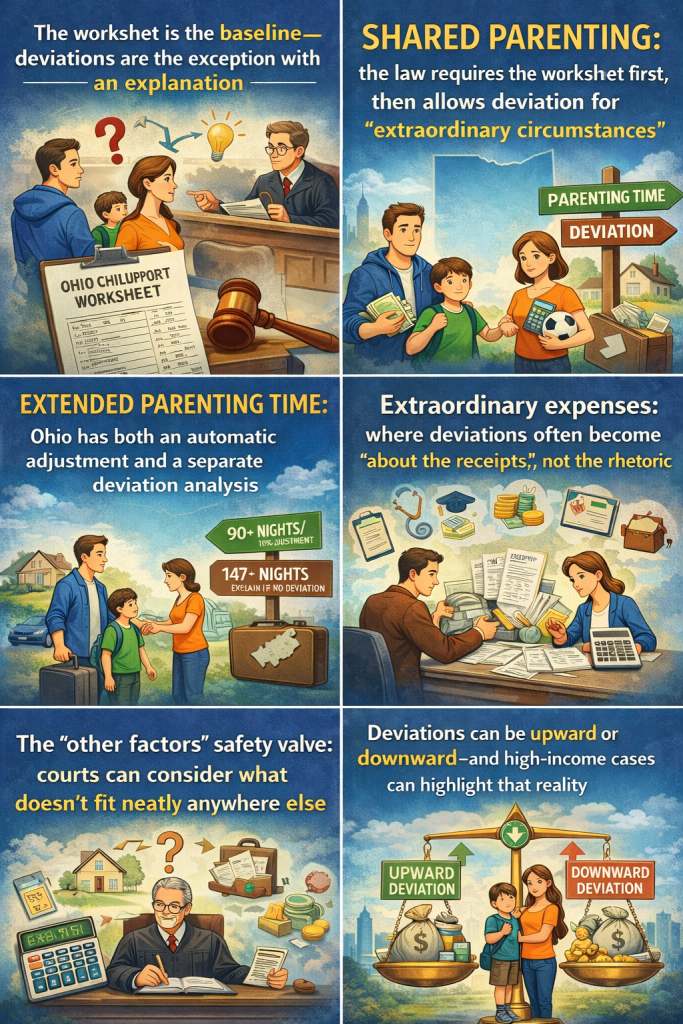
The “other factors” safety valve: courts can consider what doesn’t fit neatly anywhere else
Ohio’s deviation statute includes an “any other relevant factor” provision, R.C. 3119.23(Q), but with a caution: if a deviation is granted under that catch-all, the court must specifically state the facts that are the basis for the deviation. (Ohio Laws)
This matters because family finances often involve complexities that are real, significant, and not easily categorized—blended-family cost sharing, unusual debt structures, irregular income patterns, or child-focused arrangements the parents have built over time.
Ohio’s “any other relevant factor” language does not guarantee a deviation. It does, however, signal that the statute anticipates real-world variety—and requires the court to articulate its reasoning if it relies on that open-ended factor. (Ohio Laws)
Deviations can be upward or downward—and high-income cases can highlight that reality
When most people hear “deviation,” they think “downward” (a reduction). Ohio law doesn’t limit deviations that way. The statutory question is whether the guideline amount is unjust or inappropriate and not in the child’s best interest—not whether it is too high or too low.
A good illustration appears in In re R.M.H. (2025-Ohio-2452), where the decision describes an upward deviation beyond the worksheet numbers and references the “unjust and inappropriate” and best-interest framing. (Supreme Court of Ohio)
High-income cases can make the deviation concept feel more visible because the worksheet can produce a figure that one party views as detached from the child’s actual reasonable needs—or, conversely, a figure a court views as inconsistent with the standard of living analysis that appears in the deviation factors. Ohio’s deviation statute includes consideration of the standard of living and circumstances of each parent and the standard of living the child would have enjoyed had the marriage continued (or had the parents been married). (Ohio Laws)
Even outside high-income cases, the main takeaway is simple: deviations are not inherently “reductions.” They are departures—up or down—grounded in statutory factors and articulated findings. (Ohio Laws)

What the state’s calculator suggests about how Ohio conceptualizes deviations
Ohio’s online child support calculator interface includes inputs that explicitly reference court-ordered deviations, including extended parenting time and other factors as deviation categories. (Ohio Child Support Calculator)
That doesn’t decide any individual case, but it does reinforce the statutory architecture: the guideline amount is a baseline, and deviations are treated as identifiable categories—especially parenting-time-related deviations and “other factors” deviations. (Ohio Child Support Calculator)
A practical way to think about deviations: the statute is asking “what makes this family different?”
When a court deviates, it is effectively saying: “The worksheet was designed for the typical case. This case has features that make the typical result unjust or inappropriate.”
Ohio’s deviation-factor list in R.C. 3119.23 is best read as a map of what the legislature considers “case features” that can justify a different result:
- needs of the child (including unusual medical/psychological needs),
- the reality of parenting time and the costs it creates (especially travel),
- the resource picture across households (including income disparity and shared living expenses),
- the child’s standard-of-living interests, and
- unusual cost structures like extraordinary child care or significant in-kind contributions. (Ohio Laws)
And then R.C. 3119.22 adds the procedural discipline: if the court departs from the worksheet number, it must say what the worksheet number was and why it deviated. (Ohio Laws)
Closing note
Deviations are where Ohio child support law openly admits that “one size fits most” is not the same as “one size fits all.” The worksheet provides stability and uniformity; deviations provide flexibility—but only within a framework that is tied to statutory factors and explained findings. (Ohio Laws)

How Andrew Russ Advocates for Ohio Fathers
Clear strategy from day one: We map the custody/visitation path that fits your goals and facts.
Focused evidence development: We identify the proof that matters—and cut what doesn’t.
We are prepared to try your case when necessary.
Call Now:
Ready to take the next step? Schedule a strategy session with Andrew Russ, Ohio Family Law Attorney. Call (614) 907-1296 or complete our quick online consultation form to get started. Evening and virtual appointments available.
Educational only; not legal advice. This is a general overview of Ohio law and concepts and is not tailored to any specific facts.
© Andrew Russ Law, LLC • Educational content only • Columbus & Athens, Ohio









 Andrew Russ Law