By Andrew Russ, Ohio Father’s Rights Attorney
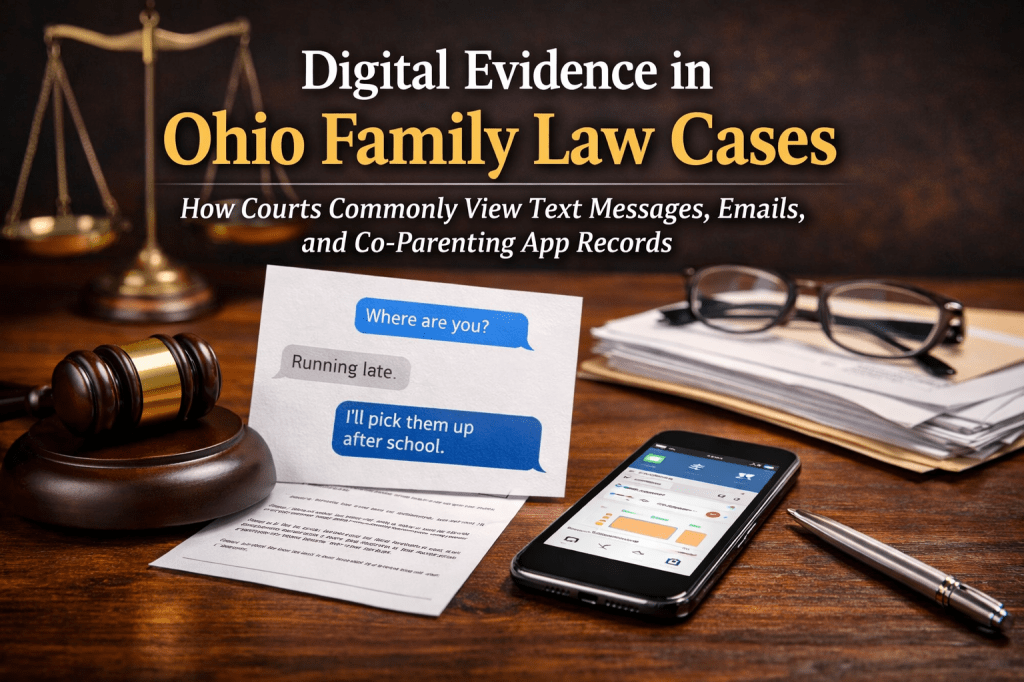
Family law disputes in Ohio increasingly unfold in a digital environment. Parents who once relied on phone calls, handwritten notes, or in‑person conversations now communicate primarily through text messages, emails, and structured co‑parenting platforms. In domestic relations and juvenile courts across Athens, Central Ohio, and Southeastern Ohio, judges regularly encounter disputes where electronic communication forms a significant part of the factual background. Understanding how courts commonly view and evaluate this material provides valuable educational insight into modern family‑law proceedings.
This article offers an educational overview of how Ohio family courts generally approach digital evidence in custody, parenting‑time, and support‑related cases. Rather than providing instruction or legal advice, it explains recurring themes seen in courtroom practice and judicial reasoning, particularly in courts serving Athens County, Franklin County, and surrounding Southeastern Ohio jurisdictions.

Digital Communication and the Modern Ohio Family Law Case
Family law cases reflect broader social changes. As daily life has shifted toward digital communication, family courts have adapted to evaluating new forms of information. Text messages between parents, email exchanges regarding schedules or expenses, and records generated by co‑parenting applications now appear routinely in hearings and filings.
In Ohio domestic relations and juvenile courts, digital communication often arises in cases involving parenting‑time disputes, allegations of poor communication between parents, or disagreements about compliance with court orders. Judges do not view this trend as unusual. Instead, electronic records are now treated as a common category of evidence that must be examined alongside testimony, financial documents, school records, and other traditional materials.
Courts in Athens and Southeastern Ohio often see cases where parents live in different towns or counties, making electronic communication the primary means of coordination. Central Ohio courts, particularly in larger metropolitan areas, similarly encounter extensive digital records due to busy schedules and complex parenting arrangements. Across these regions, the presence of digital evidence reflects the realities of modern co‑parenting rather than an exceptional circumstance.

Common Types of Digital Evidence Seen in Ohio Family Courts
Ohio family courts encounter a wide range of electronic materials. While the specific content varies from case to case, several categories appear with notable frequency.
Text messages are among the most common forms of digital communication presented in custody and parenting‑time matters. These may include conversations about exchanges, schedule changes, school events, or disagreements between parents. Courts often see both isolated messages and longer message threads spanning weeks or months.
Email correspondence also plays a significant role, particularly in cases involving more formal communication. Emails regarding education, medical care, extracurricular activities, or financial matters often appear in contested proceedings. Because emails typically contain date and time information, courts frequently review them as part of broader factual narratives.
Screenshots of messages or social‑media content are another recurring form of digital evidence. These images may capture portions of conversations, posts, or comments that parties believe are relevant to parenting issues. Courts commonly examine screenshots alongside other materials to understand their context and significance.
Co‑parenting application records have become increasingly common in Ohio cases. These platforms generate structured communication logs, calendars, and activity records. Judges in Athens, Central Ohio, and Southeastern Ohio regularly encounter references to such platforms in both domestic relations and juvenile court matters.
Finally, courts sometimes review social‑media content when it relates directly to parenting issues. While not every online post is relevant, courts may encounter social‑media material when it intersects with allegations raised during litigation.

How Ohio Courts Commonly Evaluate Digital Evidence
Ohio family courts do not treat digital evidence as inherently decisive or insignificant. Instead, judges commonly evaluate electronic records using the same foundational principles applied to other forms of evidence.
One recurring theme in judicial analysis is authenticity. Courts typically examine whether the digital material appears to be a genuine record of communication rather than an altered or incomplete representation. This assessment often involves considering the source of the material, the consistency of formatting, and whether the content aligns with other evidence in the case.
Context also plays a central role in how judges view digital communication. Isolated messages may carry limited meaning when viewed alone. Courts frequently look at surrounding communications, timing, and circumstances to understand what a particular message reflects about the parties’ interactions.
Timing and continuity are additional factors courts often consider. Judges may note whether digital records reflect ongoing patterns of communication or isolated incidents. In custody and parenting‑time disputes, courts commonly focus on trends rather than singular exchanges.
Completeness is another recurring consideration. Partial message threads or selected screenshots may be weighed differently than complete communication histories. Courts often prefer to understand how conversations unfolded over time rather than relying solely on excerpts.

Screenshots Versus Full Communication Records
Ohio family courts regularly encounter both screenshots and longer communication logs. Judges are familiar with the practical differences between these formats and often take those differences into account.
Screenshots typically present a snapshot of a specific moment. They may capture language, tone, or reactions that parties believe are significant. However, courts frequently note that screenshots may omit surrounding context, earlier messages, or subsequent responses. As a result, judges often treat screenshots as part of a larger evidentiary picture rather than as standalone proof.
Full communication records, such as message exports or application‑generated logs, tend to provide a broader view of interactions. These materials may show frequency, consistency, and changes over time. Courts in Athens and Central Ohio often emphasize the value of understanding communication patterns rather than focusing exclusively on individual messages.
That distinction does not mean one format is always preferred. Instead, courts typically consider how each type of record contributes to understanding the factual circumstances presented in the case.

Co‑Parenting Applications and Judicial Perspectives
Co‑parenting applications have become increasingly visible in Ohio family law proceedings. Courts encounter these platforms both when their use has been ordered and when parents have voluntarily adopted them.
Judges commonly view application records as structured forms of communication that can reflect scheduling coordination, responsiveness, and consistency. Because these platforms often log dates and times automatically, courts may consider them useful for understanding how communication unfolded.
At the same time, Ohio courts generally recognize that application records represent one aspect of the overall parenting dynamic. Judges often evaluate these records alongside testimony, school records, and other evidence rather than treating them as determinative.
In Southeastern Ohio jurisdictions, where parents may live some distance apart, co‑parenting applications frequently appear in cases involving transportation, exchanges, and coordination across county lines. In Central Ohio, courts often see application records in more complex cases involving multiple activities and shared parenting plans.

The Limits of Digital Evidence in Ohio Family Law Cases
Despite the growing role of electronic communication, Ohio courts consistently emphasize that digital evidence rarely resolves family law disputes on its own. Judges typically view digital records as part of a broader evidentiary framework.
Family law cases often involve nuanced questions about credibility, parenting capacity, and the best interests of children. Digital communication may illustrate aspects of those issues, but courts generally rely on multiple sources of information.
Judges also recognize that digital communication can be influenced by stress, conflict, or misinterpretation. As a result, courts often avoid drawing sweeping conclusions based solely on electronic messages without corroborating evidence.
This measured approach is consistent across Athens, Central Ohio, and Southeastern Ohio courts. While digital evidence is now routine, it is rarely viewed in isolation.
Why Educational Understanding Matters
Misunderstandings about digital evidence can create unrealistic expectations about family court proceedings. Some parties assume that a single message or screenshot will carry decisive weight. Others believe digital communication is irrelevant or ignored.
Ohio family courts occupy a middle ground. Judges routinely review electronic records, but they do so within established evidentiary principles and broader factual contexts. Understanding this approach helps explain why courts often focus on patterns, credibility, and overall circumstances rather than isolated digital moments.
For parents navigating family law matters in Athens, Central Ohio, or Southeastern Ohio, recognizing how courts commonly evaluate digital communication provides clarity about modern judicial practice. It underscores that technology has changed the form of evidence, but not the foundational reasoning courts apply when resolving family disputes.

Conclusion
Digital evidence has become a normal feature of Ohio family law cases. Text messages, emails, screenshots, and co‑parenting application records now appear regularly in custody, parenting‑time, and support proceedings across Athens, Central Ohio, and Southeastern Ohio.
Ohio courts approach these materials with careful analysis, focusing on authenticity, context, timing, and completeness. Rather than elevating digital evidence above all else, judges incorporate it into broader evaluations that include testimony and traditional documentation.
As family law continues to evolve alongside technology, understanding how courts commonly view digital communication remains an important educational topic. By examining judicial perspectives rather than offering instruction, this overview highlights how modern family courts adapt to contemporary forms of evidence while maintaining consistent analytical principles.

How Andrew Russ Advocates for Ohio Fathers
- Clear strategy from day one: We map the custody/visitation path that fits your goals and facts.
- Focused evidence development: We identify the proof that matters—and cut what doesn’t.
- Negotiation + litigation readiness: Many cases resolve with strong parenting plans; we’re prepared to try your case when necessary.
- Local insight: Familiarity with Ohio courts and procedures helps us move efficiently and effectively.
Call Now:
Ready to take the next step? Schedule a strategy session with Andrew Russ, Ohio Family Law Attorney. Call (614) 907-1296 or complete our quick online consultation form to get started. Evening and virtual appointments available.

Legal Sources on Parenting Issues:
- Ohio allocation of parental rights & shared parenting (R.C. 3109.04). (Ohio Laws)
- Parenting time statute and scheduling (R.C. 3109.051). (Ohio Laws)
- Presumptions and establishment of paternity (R.C. 3111.03). (Ohio Laws)
- Paternity acknowledgment routes (Ohio Centralized Paternity Registry). (ODJFS)
- Child support worksheet and definitions (R.C. 3119.022; 3119.01). (Ohio Laws)
andrewrusslaw.com Blog:
- Mediation, Settlement, and Negotiation in an Ohio Divorce
- Property Division in an Ohio Divorce
- Dissolution of Marriage in Ohio
- Spousal Support in Ohio Divorce Cases
- Modification of Spousal Support by Ohio Courts
- How Ohio Courts Calculate Child Support
- Modification of Child Support in Ohio
- Role of the Guardian Ad Litem in Ohio Custody and Divorce
- The UCCJEA in Ohio Courts
- Ohio Juvenile Law and Procedure
Disclaimer: This article provides general information and is not legal advice. Legal outcomes vary by facts and jurisdiction. Consult an attorney about your specific situation.

LINKS:
https://www.andrewrusslaw.com/
https://share.google/jt5uwH1ApFQIzrRdU
https://maps.app.goo.gl/XGHud9PfpxUR7hmJA
https://www.andrewrusslaw.com/contact
https://buckeyefatherslaw.com/
https://www.yelp.com/biz/buckeye-fathers-law-pickerington
https://www.andrewrusslaw.com/in-person-representation
https://www.andrewrusslaw.com/team
https://www.andrewrusslaw.com/blog
https://www.andrewrusslaw.com/about-1
https://www.supremecourt.ohio.gov/
https://codes.ohio.gov/ohio-revised-code
https://www.co.athensoh.org/departments/domestic_relations_division.php
Disclaimer: The blog and articles provide general educational information, are not legal advice, and do not create an attorney/client relationship. Legal outcomes vary by facts and jurisdiction. Consult an attorney about your specific situation.
© Andrew Russ Law, LLC • Educational content only • Columbus & Athens, Ohio

 Andrew Russ Law